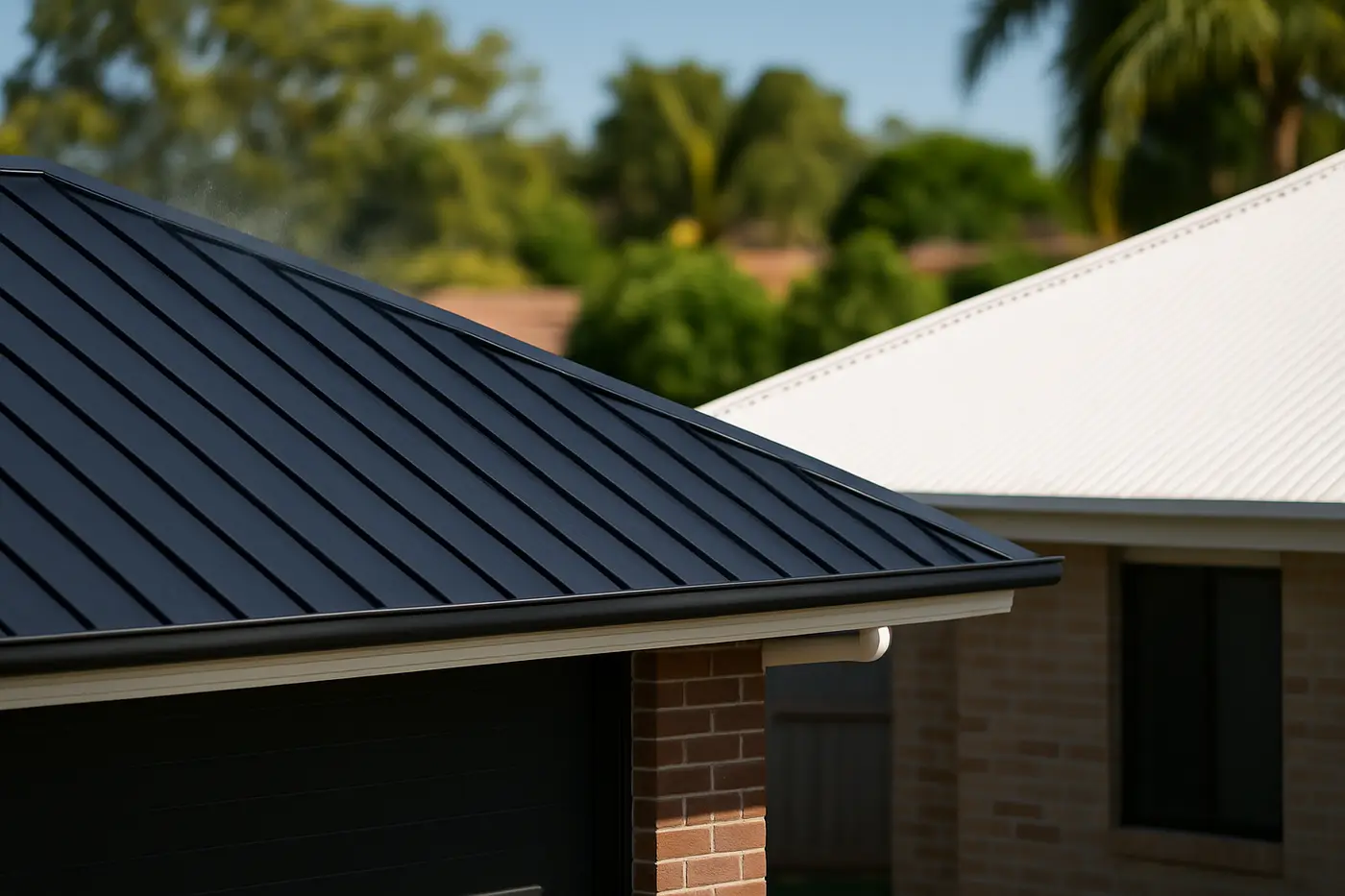
Stand on any hill in Brisbane and look across the rooftops: pale greys and off-whites in the new estates, faded terracotta and weathered concrete tile through the middle-ring suburbs, and a scatter of fashionable charcoal on renovated homes. Those colours aren’t just taste — in our climate they’re a real performance decision.
If you’re choosing a colour for a re-roof, a roof painting job or a full restoration, this guide explains the science in plain terms, what it means for comfort and power bills, and how colour plays at resale.
Solar absorptance: the one number that matters
Every roof colour has a solar absorptance (SA) value between 0 and 1 — the fraction of the sun’s energy the surface absorbs rather than reflects.
- An off-white roof at around SA 0.30 absorbs about 30 per cent of the solar energy hitting it.
- A black or deep charcoal roof at around SA 0.80 absorbs about 80 per cent.
On a 32-degree Brisbane afternoon, that difference is dramatic at the surface: a light roof might sit in the 40s while a dark roof pushes past 70 degrees. Some of that heat re-radiates to the sky, but plenty conducts down into the roof space, and from there through your ceiling — especially in older homes with thin or compressed insulation.
Roughly, colours group like this:
| Colour group | Typical SA range | Examples of the look |
|---|---|---|
| Very light | 0.30–0.40 | Off-white, pale cream, very pale grey |
| Light | 0.40–0.55 | Light grey, pale beige, light green-grey |
| Medium | 0.55–0.70 | Mid grey, brown, classic terracotta tones |
| Dark | 0.70–0.85 | Charcoal, deep grey-brown, black |
Manufacturers publish SA figures for their ranges — worth checking the exact number for a shortlisted colour rather than guessing from a swatch.
Why this is a bigger deal in Brisbane than down south
Queensland’s sun is high, strong and persistent. Brisbane cops long summers, high UV, and plenty of days where the roof is the hardest-working surface on the house. Three local realities sharpen the colour decision:
- Cooling dominates. Unlike Melbourne, where a dark roof’s winter gain has some value, Brisbane homes spend far more energy cooling than heating. A roof that absorbs less makes the air conditioner’s job easier from November to March.
- Older housing is under-insulated. A huge share of the city’s stock — pre-war Queenslanders in the inner ring, post-war homes in Ashgrove and Stafford, 60s–80s brick-and-tile in Aspley, Sunnybank and Carindale — was built with little or no ceiling insulation. The less insulation you have, the more roof colour matters.
- UV punishes dark, cheap finishes. Dark colours don’t just run hotter; the heat cycling accelerates coating breakdown. Quality finishes handle it, bargain paint jobs on dark roofs chalk and fade fast.
The BASIX-style logic, translated for Queensland
NSW homeowners know this through BASIX, which effectively penalises dark roofs on new builds unless extra insulation compensates. Queensland doesn’t run BASIX, but the same energy logic applies here through the National Construction Code’s energy-efficiency provisions: a new home’s thermal performance assessment treats roof solar absorptance as an input, and a lighter roof makes the energy targets easier (and often cheaper) to hit.
For existing homes there’s no rule stopping you repainting in charcoal — but the physics doesn’t care whether it’s a new build or a repaint. The simple version:
Light roof = free, permanent cooling assistance. Dark roof = a style choice you pay for in comfort or compensating insulation.
If you’re re-roofing or restoring anyway, pairing a lighter colour with fresh sarking and topped-up ceiling insulation is the cheapest whole-of-house cooling upgrade available.
Light vs dark: the honest trade-offs
Light colours (off-whites, pale greys):
- Coolest option, kindest to un-airconditioned rooms
- Show dirt streaks and organic growth sooner, especially under overhanging trees
- Dominate new Brisbane estates for good reason — they’ve become the default modern look
Mid tones (mid greys, muted browns, terracotta-style):
- The sensible compromise: much cooler than dark, more forgiving of dirt than white
- Terracotta and warm mid-browns suit tiled middle-ring suburbs and character streets
Dark colours (charcoal, monument-style deep greys, black):
- Strong contemporary street appeal, hides dirt well
- Hottest choice; hardest on coatings; most reliant on good insulation underneath
- Best reserved for well-insulated, well-ventilated (or heavily air-conditioned) homes
Heat-reflective coatings: dark looks, lighter behaviour
If your heart is set on a deeper colour, modern heat-reflective membrane coatings narrow the gap. They use infrared-reflective pigments so a mid or dark tone reflects considerably more solar energy than the same colour in conventional paint — the roof looks charcoal to the eye but behaves closer to a mid grey thermally.
These coatings are applied as the top coats in a proper roof restoration: pressure clean, repairs, primer/sealer, then two membrane top coats. On tile roofs, restoration also renews ridge bedding and pointing, so the colour change comes bundled with the maintenance the roof needed anyway. Preparation is everything — a reflective membrane over a chalky, unprepped surface fails early no matter what the tin promises.
What colours dominate Brisbane streets — and why
- New estates (North Lakes, Ripley, Rochedale): pale greys and off-whites on Colorbond, driven by energy rules, covenant guidelines and current fashion.
- Character suburbs (Paddington, Red Hill, New Farm): heritage-appropriate mid tones and traditional greys/greens on corrugated roofs; character overlay areas reward traditional colour choices.
- Middle-ring brick-and-tile (Aspley, Sunnybank, Carindale, Mount Gravatt): original terracotta and concrete tile colours, increasingly overpainted in mid and dark greys during restorations.
- Renovator belt: charcoal-on-white is the current renovation signature — striking, but the hottest mainstream choice.
The pattern is worth noticing for resale: a roof colour that fits its street reads as “renovated”, while one that fights its street reads as “project”.
Resale: what actually adds value
Buyers don’t consciously evaluate solar absorptance, but they respond to three things a roof colour signals:
- Condition. A freshly restored or repainted roof in a current neutral says the house has been maintained. A faded, patchy roof drags down everything below it in photos.
- Currency. Soft whites, greys and muted charcoals photograph as “now”. Bright blues, greens and reds photograph as a repaint bill.
- Coherence. Roof, gutters, render and fencing in a considered palette lifts perceived quality far beyond the cost of the paint.
If you’re preparing to sell a tired tile or metal roof, a restoration in a safe neutral is one of the few pre-sale spends that reliably pays for itself in presentation — and if the roof is beyond coating, a roof replacement in a light modern colour becomes a headline feature of the listing rather than a buyer’s negotiating chip.
Our short answer
- Best for heat: very light greys and off-whites, no contest.
- Best all-rounder: light-to-mid greys — cool enough, practical, safe at resale.
- Dark roofs: fine on a well-insulated home, better again with a heat-reflective membrane, but go in with eyes open.
Not sure whether your roof needs a colour change, a restoration or just a clean? Book a free roof inspection online and we’ll assess the surface, the coating condition and the insulation situation before you spend a dollar on colour.