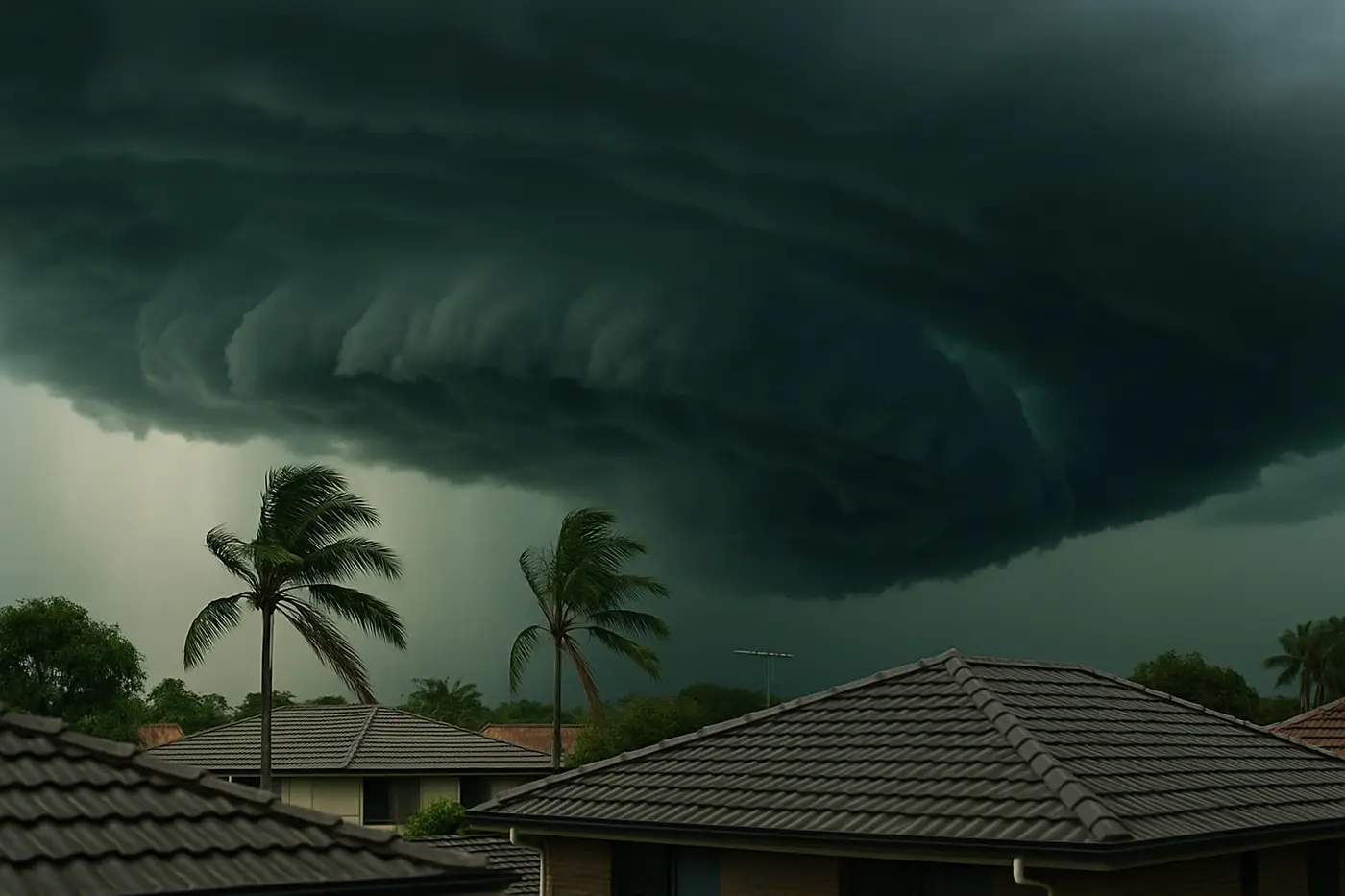
Every Brisbane roofer knows the pattern. The first serious supercell of the season — usually some hot, gluggy afternoon in November — rolls in from the south-west, drops hail somewhere between Ipswich and the bayside, and by the following Monday every roofing crew in the city is booked out for six weeks.
The homeowners who ride out storm season comfortably aren’t lucky. They’re the ones who spent a Saturday in September or October working through a checklist like this one. Here it is, roughly in order of how much grief each item prevents.
1. Clear the gutters and downpipes — properly
Blocked gutters cause more storm-season water damage in Brisbane than hail does. When 60mm of rain arrives in twenty minutes and the gutters are full of jacaranda litter, water has nowhere to go but backwards — up under the roofline, over the back of the gutter, and into the eaves and wall cavities.
Doing it properly means:
- Scooping out leaf litter along every run, not just the visible front gutters.
- Flushing each downpipe with a hose and confirming water actually exits at the bottom. A downpipe blocked at the elbow looks fine from above.
- Checking gutter fall. Standing water after the flush means the gutter has sagged and will overflow first in a downpour.
- Looking for rust spots and separated joints while you’re there.
If your home sits under established trees, consider gutter guard — but know that it reduces cleaning frequency rather than eliminating it.
2. Inspect the ridge capping and pointing
On tiled roofs, ridge capping is held down by a mortar bed and a flexible pointing compound over the top. Brisbane’s cycle of baking heat and afternoon storms works both loose over the years. Cracked or drummy pointing means ridge caps that can lift in a 90km/h gust — and a lifted ridge cap opens a straight channel for wind-driven rain.
From the ground with binoculars, look for: visible cracks along the pointing line, missing chunks of mortar, and any capping that sits proud or crooked against its neighbours. If your pointing is original on a roof more than 15 years old, it’s worth a professional look — rebedding and repointing is far cheaper than the ceiling repairs that follow a ridge failure.
3. Find the cracked and slipped tiles now
A single cracked tile admits a surprising amount of water when rain is horizontal. Walk the perimeter of the house with binoculars and scan each face of the roof in strips, looking for:
- Obvious cracks, chips, or missing corners
- Tiles sitting out of line with the course (slipped tiles)
- Lichen-heavy patches, which can hide fractures
Don’t walk the roof yourself — concrete and terracotta tiles crack underfoot when loaded wrong, and you’ll create the problem you were looking for. A tile roof repair professional can swap damaged tiles, re-seat slipped ones, and check the sarking beneath while they’re up there.
4. Check metal roof screws and fasteners
On Colorbond and other metal roofs, the fasteners are the wear item. Roof screws have neoprene seals that perish in Queensland UV, and the screws themselves rust, back out, or wallow their holes as sheets expand and contract through thousands of hot-cold cycles.
Signs visible from the ground or a ladder at eave height: rust streaks running down from screw heads, screws sitting visibly proud, and any sheet edge that flutters or drums in moderate wind. Storm-force gusts exploit loose fasteners first — wind uplift starts at one loose sheet edge and unzips from there. A pre-season fastener check and re-screw is quick work for a metal roof repair crew and dramatically cheaper than replacing wind-damaged sheets.
5. Cut back overhanging branches
Every summer, a large share of SES call-outs in Brisbane are trees and branches on roofs. Gums in particular shed limbs in storms — sometimes without much wind at all after a dry spell.
Walk around the house and look up. Any branch overhanging the roofline is a candidate to come through the tiles in a supercell; any branch touching the roof is already abrading it and feeding the gutters. Trim back to well clear of the roof. For large limbs, height, or anything near powerlines, use a qualified arborist — and if the tree is on council land, lodge a request with Brisbane City Council rather than touching it yourself.
6. Check whirlybirds, flashings and penetrations
Everything that pokes through your roof is a potential entry point. Give five minutes each to:
- Whirlybirds: they should spin freely in a light breeze. A seized whirlybird lets wind-driven rain straight into the cavity around its base and does nothing for summer heat extraction.
- Flashings: around chimneys, skylights, vent pipes and aerials. Look for lifted edges, cracked sealant, and rust.
- Solar panel mounts: if panels were installed on a tile roof, cracked tiles under and around the mounting feet are common.
7. Look inside the ceiling cavity
Pick a dry day, take a torch, and stick your head through the manhole. You’re looking for daylight where there shouldn’t be any, water staining on the underside of sarking or on timbers, rusty drip trails below screw points, and insulation that’s discoloured or compacted in patches — all evidence of leaks that only show themselves in exactly the wind-driven rain storm season delivers.
8. Review your insurance before you need it
September is the time to read your policy, not December with a tarp on the roof. Check:
- Sum insured: rebuilding costs have risen sharply in recent years. Underinsurance is the most common nasty surprise in Queensland storm claims.
- Excess: know what you’d pay out of pocket.
- Maintenance exclusions: every policy excludes gradual deterioration. This is exactly why the items above matter — a documented, well-maintained roof takes the insurer’s easiest decline reason off the table.
- Emergency make-safe cover: most policies authorise reasonable make-safe costs; know your insurer’s process and claim line before the storm.
Keep photos of your roof in good condition, plus any inspection report or repair invoices, with your policy documents.
Why the deadline is real: the post-supercell squeeze
Here’s the economics of it. A single severe hail cell tracking across Brisbane’s southern suburbs can damage several thousand roofs in one afternoon. All of those homeowners call roofers in the same week. Insurance repair work then fills local crews’ books for months, prices for private work firm up, and materials go on back-order.
That means a repair you could book in a week in September becomes a six-to-ten-week wait in December — with a tarp on your roof and more storms in the forecast. If your pre-season check turns up anything, get the roof repair done in October, not after the first cell.
The short version
Gutters and downpipes flushed. Ridge capping sound. No cracked or slipped tiles. Metal fasteners tight and sealed. Branches cut back. Whirlybirds spinning, flashings sealed. Cavity dry. Insurance read and adequate. That’s the whole list — one weekend of ground-level checks and, if needed, one professional visit.
If you’d rather have it done properly in one go, book a free roof inspection online and we’ll go over every item on this list from on the roof, with a written photo report you can file with your insurance documents before the first November cell builds over the ranges.