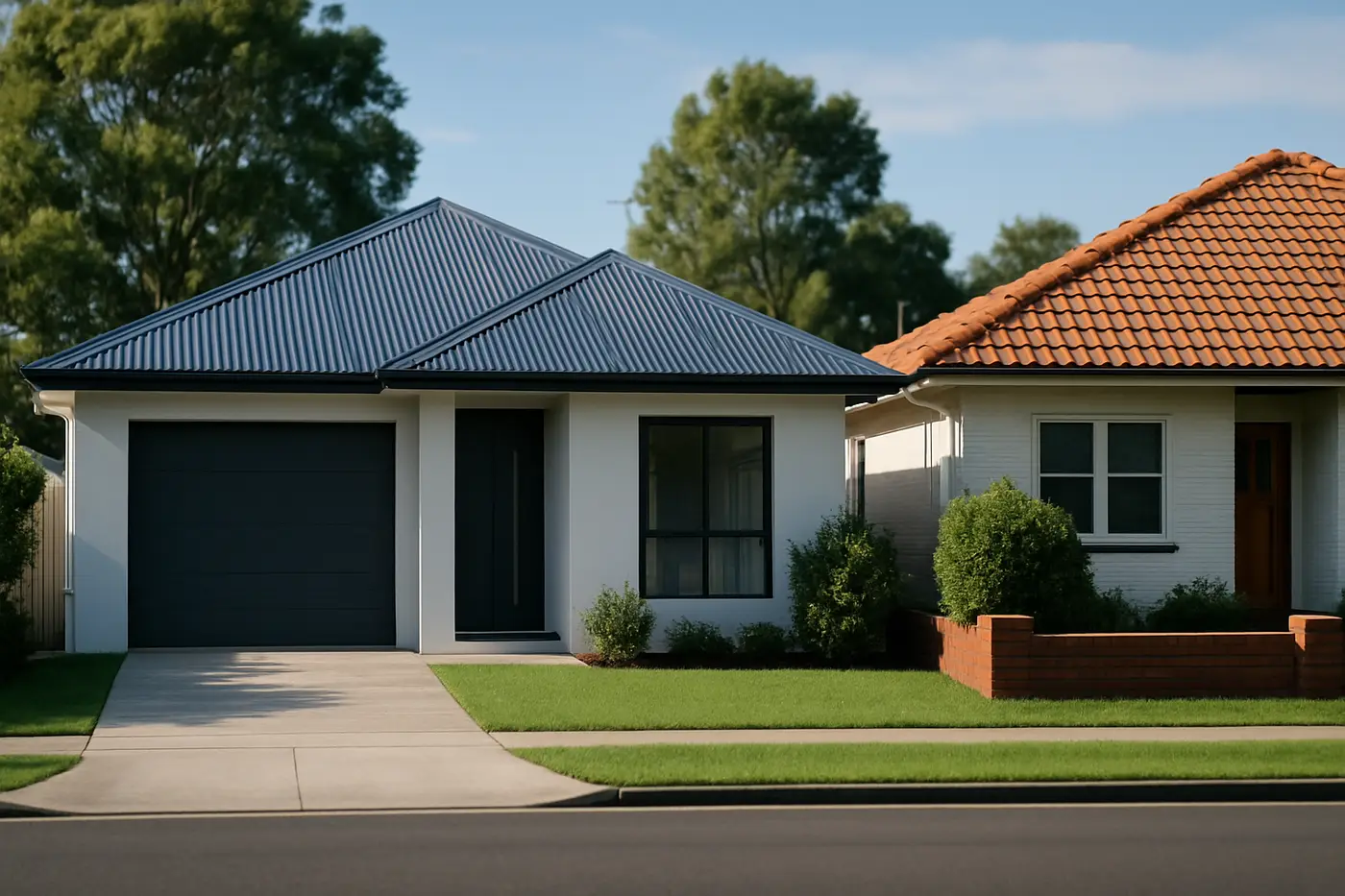
Ask a metal roofer whether you should switch to Colorbond and you’ll get one answer. Ask a tiler and you’ll get the other. Both will be selling, not comparing. This guide sets out the genuine differences between Colorbond steel and roof tiles in Brisbane conditions — subtropical UV, summer storm cells, the occasional serious hail event — so you can make the call on facts.
The quick comparison
| Factor | Colorbond steel | Concrete/terracotta tile |
|---|---|---|
| Weight | ~4-6kg/m² | ~40-55kg/m² |
| Hail | Dents (cosmetic) | Cracks (leak risk) |
| Typical service life | 40-60+ years | Tiles 50+, but bedding/pointing 10-15 |
| Maintenance | Low; fasteners and coatings | Ongoing; repointing, broken tiles |
| Heat | Reflective colours + blanket perform well | Thermal mass slows heat both ways |
| Rain noise | Quiet with anticon blanket | Naturally quiet |
| Minimum pitch | As low as 1-2° (concealed fix) | Usually 15°+ |
| Repairs | Sheet-level; needs a metal roofer | Tile-level; cheap and simple |
Weight: the difference nobody talks about enough
Concrete tiles weigh roughly 45-55kg per square metre. Colorbond sheeting weighs around 4-6kg. On a typical 200m² Brisbane roof, that’s about 10 tonnes of tile versus about 1 tonne of steel.
Why it matters here specifically: a large share of Brisbane’s housing stock is timber-framed, and plenty of older Queenslanders and post-war homes were never designed for concrete tile. Some had heavy tile retrofitted decades ago over frames built for corrugated iron. On those homes, converting back to metal takes genuine load off ageing timber — and any frame sag or spread should be assessed before you re-tile regardless.
The flip side: weight gives tile roofs excellent resistance to wind uplift and a solid, planted feel. A properly clipped and sarked tile roof performs well in storms too.
Heat: reflectivity versus thermal mass
Brisbane’s real enemy is summer radiant heat, and the two materials handle it differently.
Colorbond relies on reflectivity plus insulation. Lighter Colorbond colours reflect a significant portion of solar radiation, and modern installs include an anticon blanket — glasswool insulation bonded to reflective foil — laid directly under the sheets. The combination reflects heat, resists conduction, and controls condensation. A light-coloured Colorbond roof with a proper blanket is one of the coolest roof systems you can put on a Brisbane home.
Tile relies on thermal mass and ventilation. Tiles absorb heat slowly through the day and release it slowly at night, and the gaps between tiles let the roof cavity breathe. The downside in a Brisbane heatwave: that mass keeps radiating heat into your roof space well into the evening, exactly when you’re trying to sleep.
Verdict: a well-specified light Colorbond roof generally wins on summer heat, but a sarked tile roof with good ceiling insulation and whirlybirds is not far behind. Dark colours punish you in either material.
Hail: where Colorbond clearly wins
Brisbane cops significant hail — the 2020 Halloween storms through Springfield and Rochedale were a reminder of what a supercell can do. The materials fail very differently:
- Colorbond dents. Large hail leaves dimples. It’s ugly, and insurers argue about it, but a dented sheet almost always still keeps water out.
- Tiles crack or shatter. A cracked tile is a hole in your waterproofing. After a big hail event, tile roofs need prompt inspection and replacement of broken tiles before the next downpour finds the gaps.
If you’re in a hail-prone corridor and weighing up a re-roof anyway, this is a legitimate reason to lean metal.
The noise myth
“Metal roofs are loud in rain” is the most persistent objection we hear, and it’s about 30 years out of date. The drumming people remember comes from uninsulated sheds, patios and old lean-tos — bare steel over open air.
A modern Colorbond house roof is installed over an anticon blanket, above a plasterboard ceiling with insulation batts. That sandwich absorbs most rain noise. Tile is still marginally quieter in a torrential downpour, but the difference in a correctly built home is small enough that most owners stop noticing within a week.
Lifespan and maintenance profiles
Colorbond: the sheets themselves commonly last 40-60+ years in Brisbane when kept clean and away from severe salt exposure. The maintenance items are fasteners (screws and washers weather faster than sheets), flashings, and eventually the surface coating, which can be repainted. Rust at scratches, cut edges and fasteners is the thing to watch — our guide to metal roof repairs in Brisbane covers what early intervention looks like.
Tile: the tiles themselves can last 50+ years (terracotta often longer), but the roof is a system, and the system’s weak points age faster. Ridge cap bedding and pointing typically needs attention every 10-15 years, valley irons corrode, sarking perishes, and individual tiles crack from foot traffic and hail. Tile roofs aren’t low-maintenance — they’re cheap-to-maintain, which is different. Any competent roofer can swap a cracked tile for a few dollars of material; keeping spares from your own roof makes colour-matching trivial.
Storm performance
Both materials, properly installed to current fixing standards, handle Brisbane storm season well. The practical differences:
- Wind uplift: modern Colorbond is screw-fixed through to battens and performs excellently; older tile roofs without clips rely partly on weight, and individual tiles can lift or chatter in severe gusts.
- Debris impact: branches puncture neither easily, but they smash tiles and dent steel — again, cracked tile leaks, dented steel usually doesn’t.
- Water shedding at low pitch: Colorbond handles low-pitch sections (down to 1-2° with concealed-fix profiles) that tiles simply cannot, which matters for extensions and patio tie-ins.
Cost comparison
| Scenario | Typical Brisbane range |
|---|---|
| New build / re-roof in Colorbond | $18,000-$40,000 |
| New build / re-roof in concrete tile | $16,000-$38,000 |
| Tile-to-Colorbond conversion | $20,000-$45,000 |
| Restore existing tile roof instead | $3,500-$8,000 |
| Restore existing metal roof instead | $3,000-$7,000 |
Conversion costs more than a like-for-like re-roof because everything comes off: tiles, battens, often sarking, then new battens and blanket go on before sheeting. See our full roof replacement service breakdown for what drives the quote.
When converting to Colorbond makes sense
- Your tile roof needs major work anyway — widespread brittle tiles, failed sarking, multiple leaks — and repair quotes are approaching re-roof money
- Your timber frame is carrying tile it was never designed for
- You’re in a hail corridor and tired of post-storm tile replacement
- You’re extending with low-pitch sections that tile can’t cover
- You want a one-and-done roof with minimal ongoing maintenance
When keeping tile is the smarter call
- The tiles are structurally sound and the problems are bedding, pointing or a handful of cracked tiles — a roof restoration at a fifth of the cost buys you another 10-15 years
- You own a character home (Queenslander, interwar bungalow) where terracotta is part of the streetscape and the value
- Your budget rules out $25,000+ this year — targeted repointing and rebedding keeps a sound tile roof watertight for a fraction of conversion cost
- The frame hasn’t been assessed — never assume it can take a change of load path without a look
The honest bottom line
If we were re-roofing from scratch in most Brisbane suburbs today, we’d lean Colorbond: lighter, better in hail, less ongoing maintenance, and the noise objection no longer holds. But “Colorbond is better” is not the same as “you should convert.” A structurally sound tile roof with tired pointing doesn’t need $30,000 of steel — it needs a proper restoration.
Not sure which side of that line your roof sits on? Book a free roof inspection online and we’ll give you the same honest comparison for your actual roof, with photos and numbers.