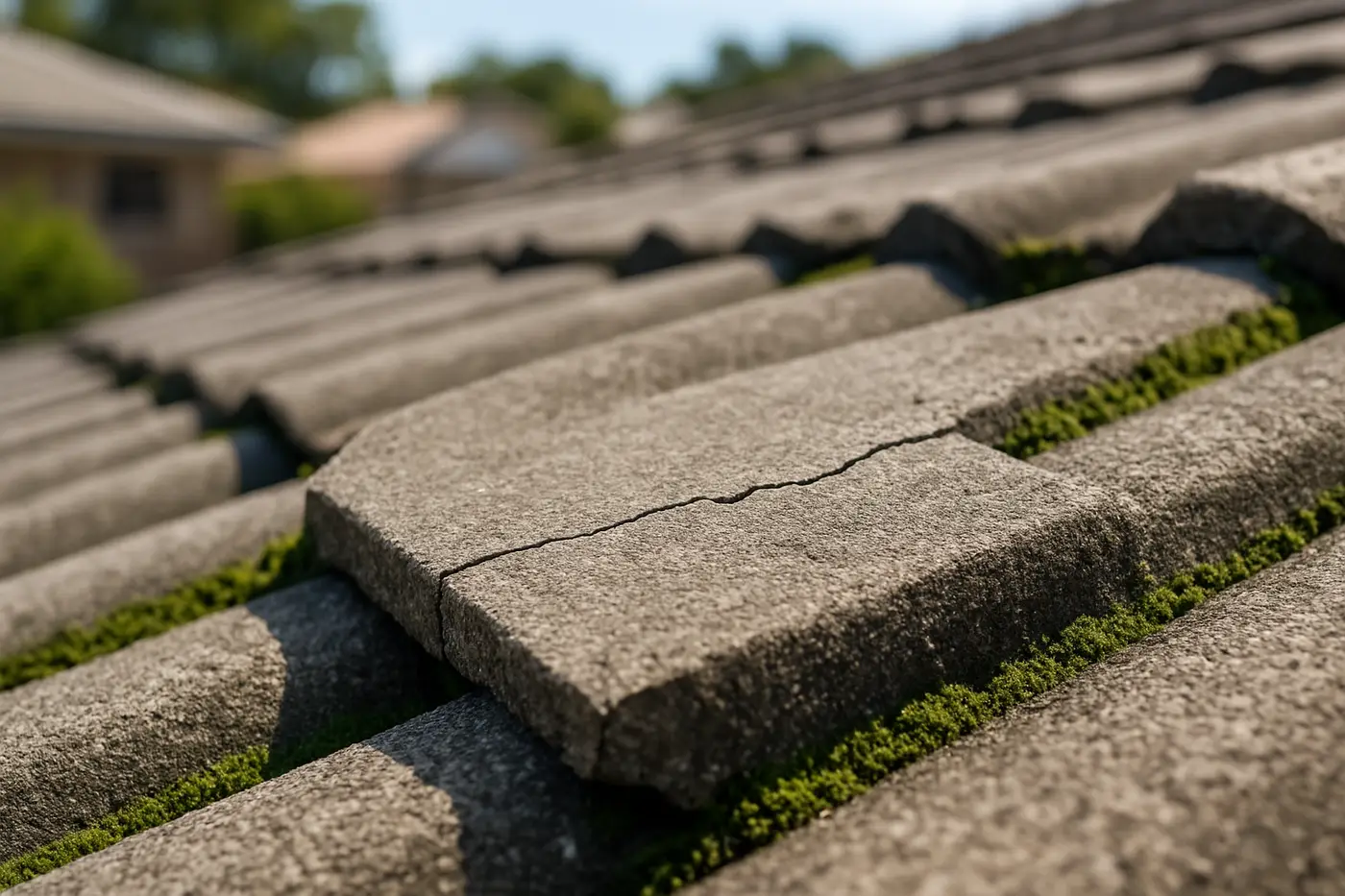
Every tiled roof in Brisbane has cracked a tile at some point — a November hail cell, an antenna installer’s boot, or simply forty summers of expansion and contraction will do it. The question is never whether tiles crack. It’s what the cracking means: a twenty-minute fix, a restoration, or the first sign a roof is finished.
This guide gives you the diagnostic logic we use on inspections across Brisbane’s tile suburbs — Aspley, Sunnybank, Carindale, Mount Gravatt, Wishart and the rest of the brick-and-tile belt — plus rough costs for each path.
Why tiles crack in the first place
Hail. South-East Queensland’s storm season throws hail at roofs most years, and serious cells crack tiles by the dozen. Hail damage has a signature: cracks and fresh chips concentrated on the planes facing the storm, often with clean impact points, all appearing at once. If your roof matches that pattern after a storm, photograph everything before repairs — it matters for the hail insurance claim process.
Foot traffic. The most common cause we see, and the most avoidable. Tiles are strong across their supported points and weak mid-span; a boot in the wrong spot cracks them instantly. Crack trails leading to the TV antenna, the air conditioner, the solar array or the satellite dish tell you exactly who to thank. Older, more brittle tiles crack under even careful feet.
Age and brittleness. Concrete tiles lose surface and eventually go friable (“fretting”); terracotta gets harder but more glass-brittle as decades pass. On an old roof, tiles begin cracking under stresses they used to shrug off — thermal cycling, wind lift, a possum’s landing.
Everything else. Falling branches, thrown debris in storms, poorly installed fixings around penetrations, and the occasional manufacturing flaw that shows up years later.
Reading the pattern: the real diagnostic
Individual cracked tiles are trivia. The pattern is the diagnosis:
| Pattern | Likely cause | What it means |
|---|---|---|
| Cluster on storm-facing planes, sudden onset | Hail | Repairable; document for insurance |
| Line of cracks tracking to roof equipment | Foot traffic | Repairable; brief future trades on roof access |
| Cracks concentrated at ridges/hips with loose cappings | Failed bedding and pointing stressing tiles | Rebed/repoint plus tile swaps |
| Random cracks appearing across all planes, ongoing | Age-brittle tiles | Systemic — restoration window closing, plan bigger |
| Cracking plus surface crumbling and gritty gutters | Fretting (concrete) | Tiles at end of life; coating won’t save them |
The first three patterns are maintenance. The last two are a roof telling you its era is ending — and the worst money you can spend is a decade of piecemeal patching on a roof in systemic decline.
What a proper spot repair looks like
The correct fix for a cracked tile is simple: replace it. A tiler lifts the overlapping tiles, removes the cracked one, and slides in a matched replacement — no sealant, no glue, done in minutes once they’re up there.
The craft is in the matching. Most Brisbane tile profiles are discontinued, so good repairers work the second-hand market — roof strippers and tile recyclers hold pallets of the common old profiles. Where colour match is imperfect (it usually is, against 30 years of weathering), the pro move is harvesting sound tiles from a hidden plane for the visible repair and putting the odd-coloured donors where nobody looks. We cover matching in more depth in our terracotta vs concrete comparison.
While anyone’s on the roof, they should also check the surrounding bedding, pointing and valley condition — cracked tiles and failed pointing frequently travel together, and fixing both in one visit is far cheaper than two call-outs. That’s the core of our tile roof repair service.
The silicone red flag
Here’s a pattern every Brisbane tile-roof owner should know: get up in the ceiling space or look closely at photos of your roof, and if you find silicone, mastic or roofing goop smeared along tile cracks, treat it as a warning sign about whoever worked on the roof last.
Why it’s a red flag:
- It fails fast. Queensland UV cooks exposed sealant; most crack “repairs” split or peel within a couple of years, and the leak returns.
- It can make things worse. Sealant in the wrong place dams water that the tile overlap system was designed to shed, redirecting it under tiles.
- It complicates the real fix. Silicone-glued tiles break their neighbours when they’re finally lifted for proper replacement.
- It signals a patch-merchant. A repairer who seals instead of replaces was optimising for the invoice, not the roof. Check what else they “fixed”.
There are legitimate niche uses for sealants on a tile roof (some flashing details, for instance). A visible crack glued shut is not one of them. When a quote’s method statement says “seal cracked tiles”, keep shopping — and verify the roofer’s QBCC licence while you’re at it.
Repair, restore or replace: the decision framework
Spot repair — when:
- Fewer than roughly a dozen cracked tiles, with a clear one-off cause (hail, trades, branch)
- Tiles are otherwise sound: surfaces intact, no fretting, bedding mostly serviceable
- Rough cost: low hundreds for a call-out and a handful of swaps; matched salvage tiles can add supply cost for rare profiles.
Restore — when:
- Cracking is moderate and accompanied by tired-but-sound tiles: faded surfaces, failed pointing, lichen — but no widespread fretting or brittleness
- You want another 10–15 years from the roof without replacement money
- A full roof restoration bundles the lot: clean, replace all cracked tiles, rebed and repoint ridges, and (for concrete tiles) a membrane recoat
- Rough cost: typically several thousand dollars on an average Brisbane home — a fraction of re-roofing.
Replace — when:
- New cracks keep appearing across all planes with no event to blame
- Concrete tiles are fretting (crumbling surface, sandy gutters) or terracotta is shattering under normal handling
- Repair visits have become an annual subscription
- Rough cost: a five-figure project on most homes — but it resets the roof for decades and stops the leak-patch-leak cycle. See roof replacement for what’s involved.
The honest test we apply on inspections: if replacing every currently cracked tile still leaves you expecting more cracks next season, the roof — not the tiles — is the problem.
Don’t wait for the ceiling stain
A cracked tile costs less to fix than almost anything else on a house. The water damage it eventually causes — soaked sarking, stained plaster, rotted battens, mouldy insulation — costs many multiples more, and Brisbane’s storm season stress-tests every weakness annually.
If you’ve spotted cracked tiles, had hail through recently, or just haven’t had the roof looked at since the antenna went up, book a free roof inspection online. We’ll count and photograph every cracked tile, check the bedding and pointing, and tell you plainly which of the three paths — repair, restore or replace — your roof is actually on.