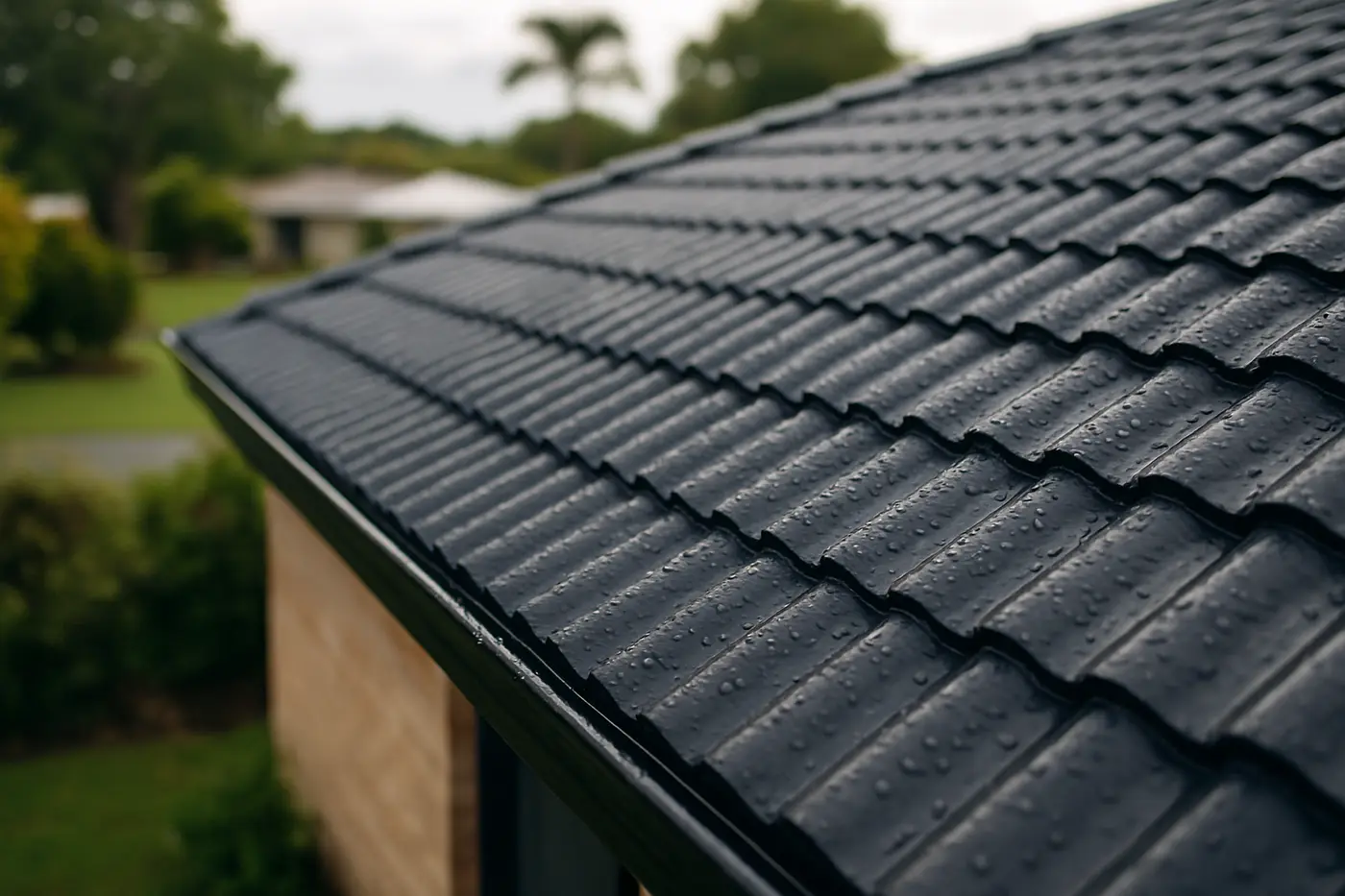
“How long will it last?” is the question every restoration quote should answer plainly, and most don’t. The honest answer for Queensland: 10-15 years for a properly executed restoration, with some components lasting longer and one — the membrane — doing all the heavy lifting against the harshest UV environment in the country.
Here’s the lifespan story component by component, what quietly shortens it, and how to know when a roof has had its last restoration.
Lifespan by component
A roof restoration isn’t one thing; it’s a bundle of jobs that age at different rates.
| Component | Realistic Queensland lifespan | Notes |
|---|---|---|
| Flexible repointing | 10-15 years | Modern flexible compound; rigid mortar pointing lasted far less |
| Rebedding (ridge caps) | 15-25 years | Sand-cement bedding under the caps outlasts the pointing on top |
| Membrane coating (2 coats, primed) | 10-15 years | The limiting component; warranty tiers vary by product |
| Membrane coating (cheap 1-coat) | 2-5 years | Chalks and fails early under QLD UV |
| Replaced tiles / new screws | 20-50 years | Effectively permanent relative to the coating |
| Pressure clean alone | 1-3 years | Cosmetic; moss and lichen return without coating |
Two things stand out. First, the membrane is the clock — everything else on the list generally outlives it. Second, the spread between a good coating and a cheap one is enormous: a factor of three to five in service life for maybe 20-30% difference in price.
Membrane warranty tiers
Reputable coating manufacturers back their systems with written warranties, and the tiers roughly track reality: entry-level acrylic systems typically carry shorter warranties, while premium heat-reflective membranes applied at specified thickness over primer commonly carry 10-15 year terms. Ask two questions of any quote: which product, and how many coats? A contractor who can’t name the membrane system isn’t planning to honour anything.
Pointing and bedding
Modern flexible pointing compounds were the great leap forward here — the old rigid mortar cracked as roofs expanded and moved, which is why so many pre-2000s tile roofs shed pointing chunks into their gutters. Done properly, repointing should give you 10-15 years, and the sand-cement bedding beneath usually needs replacing only where it’s drummy or cracked, not wholesale.
Queensland UV is the limiting factor
Southeast Queensland receives some of the highest UV exposure of any populated region on earth, and UV is what kills coatings. It breaks down the acrylic binder at the surface, which shows up as chalking (a powdery film on your fingers), then fading, then micro-cracking, then peeling.
This is why lifespan numbers from northern-hemisphere product literature don’t translate, and why coat thickness matters so much: UV erodes membrane from the top down, so a two-coat system at full specified thickness simply has more sacrificial material than a thin single pass. Heat-reflective membranes have a side benefit here — by reflecting more solar radiation they run cooler, and cooler coatings degrade more slowly.
What shortens a restoration’s life
Almost every restoration that fails early fails for one of these reasons:
- No primer or sealer coat. Membrane needs a bound, sealed surface to grip. Straight onto chalky old paint or porous concrete tile, it peels in sheets — often within two summers.
- Thin or single coats. The spec exists for a reason. One heavy pass is not two coats; it’s a short warranty pretending to be a long one.
- Coating over an unrepaired substrate. Membrane over cracked tiles, drummy bedding, rusted valleys or perished sarking just gift-wraps the problems. The leak returns, and now it’s under warranty dispute.
- Coating in the wrong conditions. Membrane applied onto a damp roof, or hours before a storm cell, never cures to full film strength.
- Skipping the clean. Any lichen or moss left alive under the coating regrows and lifts it from beneath.
If a quote is dramatically cheaper than the others, it’s nearly always because one or more of these steps has quietly disappeared. Our restoration cost guide breaks down what each stage should include.
Maintenance that stretches the lifespan
A restored roof isn’t a sealed unit — how it’s kept determines whether you get year 8 or year 15 out of the coating:
- Clear gutters and valleys at least twice a year; wet debris against the coating edge is where breakdown starts
- Trim overhanging branches — constant leaf drop, shade and abrasion create the damp zones where moss re-establishes
- Replace cracked tiles promptly so water never gets under the coated surface
- Gentle wash-down every few years to remove the grime and spore load before regrowth takes hold (never high pressure on a coated roof)
- Inspection every 1-2 years, especially after hail — coating damage is cheap to touch up early and expensive to discover late
When a second restoration makes sense — and when it stops making sense
A well-done first restoration usually earns a second one. Around the 10-15 year mark, if the tiles or sheets are still sound, a clean and recoat — essentially a roof repaint with spot repairs — costs less than the original restoration and resets the clock.
But there’s a point where restoration number two (or three) is money down the drain:
- Brittle tiles. Decades-old concrete tiles that crack underfoot can’t survive the foot traffic of the job itself, let alone another 15 years.
- Perforated metal. Coating doesn’t bridge holes; rusted-through sheets need steel, not membrane.
- Multiple failed layers. Membrane over peeling membrane over old paint fails at the weakest layer beneath. At some point the honest prep cost (stripping back) approaches silly money.
- Restoration quotes at 40-50% of replacement. When repairs plus coating creep toward half the cost of a new roof that will last 40+ years, replacement usually wins the ten-year maths.
A trustworthy roofer will tell you which side of that line you’re on before taking your deposit — and should be willing to put the remaining life of your current roof in writing.
The short version
Budget on 10-15 years from a quality restoration in Queensland, treat any promise much beyond that with suspicion, and treat any price that implies much less as exactly what it is. The membrane system, the primer, the coat count and the substrate repairs are where the years live.
Wondering how many years your current roof — or your last restoration — has left? Book a free roof inspection online and we’ll give you a component-by-component answer with photos.