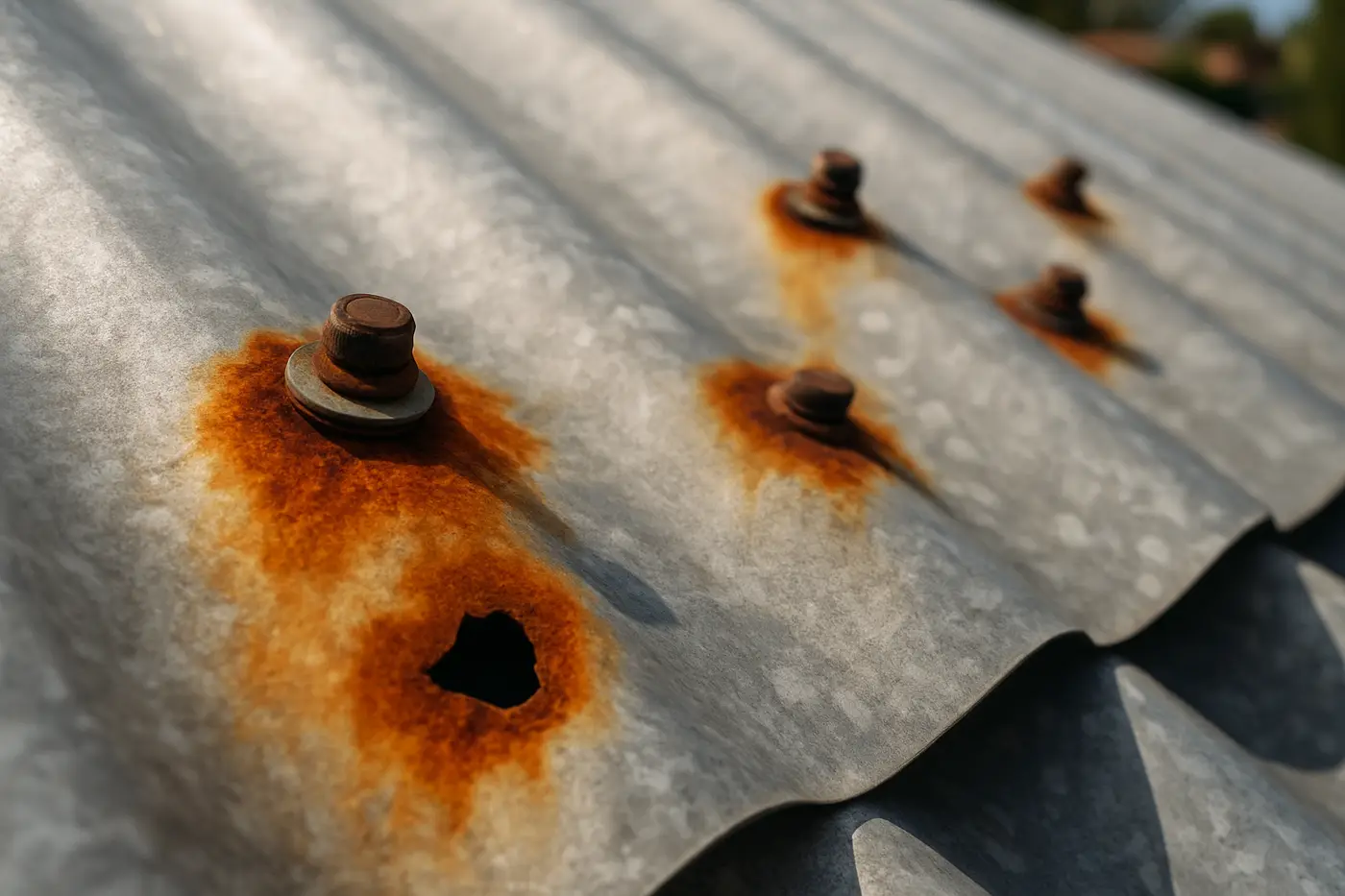
Rust is the one problem every Brisbane metal roof eventually has to answer for. Humid subtropical summers, ferocious UV, storm-driven debris that scratches coatings, and — for the eastern suburbs — salt air rolling in off Moreton Bay. The good news is that rust follows a predictable sequence, and at every stage before perforation there’s a sensible, affordable repair.
This guide walks through that sequence: what’s cosmetic, what’s urgent, and which repair actually suits each stage.
Surface rust vs perforation: the line that decides everything
Every decision about rust repair comes down to one question: is the steel still there?
Surface rust is oxidation on top of intact steel — a scratched coating, a cut edge, water staining around a fastener. The metal underneath still has its full thickness. This is treatable: clean, convert, prime, coat.
Perforation means rust has eaten through the sheet. You’ll see pinholes of daylight from inside the roof space, flaking laminated rust, or edges that crumble under a fingertip. No coating on earth restores missing steel. Perforated sections need replacement — a sheet, a valley iron, a flashing.
The rough rule: if you can push a screwdriver tip through it, or the rust flakes off in layers rather than sanding off as powder, you’re past the coating stage.
Fastener rust: the usual first failure
On most Brisbane metal roofs, the screws go first — often a decade or more before the sheets show anything. Three reasons:
- Mismatched materials. Screw heads and washers frequently carry a lower grade of coating than the sheet itself.
- Perished washers. The EPDM seal under each screw head cooks under Queensland UV, cracks, and lets water sit against the shank.
- Exposed steel at the hole. Every screw hole is a ring of bare steel the factory coating never touched.
The tell-tale is a rust ring or brown streak running down-slope from screw heads. The fix is straightforward and cheap relative to what it prevents: replace affected fasteners with new oversized screws (one gauge up, so they bite fresh steel) with new sealing washers. On older roofs we often recommend a full re-screw while we’re up there — piecemeal replacement on a roof where every washer is the same age is false economy. Our metal roof repair team in Brisbane does this as a standalone job constantly.
Ignore fastener rust long enough and it stops being a fastener problem: the rust migrates into the sheet around the hole, and now you’re cutting steel.
Valleys and box gutters: where Queenslanders rust through
If you own a Queenslander or interwar timber home, your roof’s most vulnerable steel isn’t the visible sheeting — it’s the valley irons and box gutters buried in the roof geometry.
Valleys concentrate everything: double the water volume, plus every leaf, seed pod and jacaranda flower the roof catches. Wet debris sitting in a valley holds moisture against the steel for weeks, and many older valleys are original galvanised iron that lost its zinc decades ago. Box gutters — common where old extensions meet the main roof — are worse again, because they’re flat-bottomed, slow-draining and invisible from the ground.
Signs you have a valley or box gutter problem:
- Brown staining on ceilings that tracks a straight diagonal line
- Leaks that only appear in heavy rain, not showers
- Rust flakes or “tea-coloured” water discharging from one downpipe
- Daylight visible along a valley line from inside the roof space
Salt air near Moreton Bay
Corrosion isn’t uniform across Brisbane. Within roughly a kilometre of the bay — Wynnum, Manly, Lota, Sandgate, Brighton, Redcliffe, Cleveland — salt deposition puts roofs in a measurably more corrosive environment, and even suburbs a few kilometres inland see accelerated wear on the sheltered areas rain never rinses: under eaves, behind chimneys, the tops of walls under roof overhangs.
Practical implications for bayside owners:
- Rinse unwashed areas with fresh water a couple of times a year — the rain-washed roof surface often outlasts the sheltered flashings
- Watch cut edges (gutter lines, flashing edges) where bare steel is exposed; they fail first in salt air
- When replacing anything, specify the appropriate higher-grade coating class for coastal exposure — it costs little more at purchase time
Repair options, matched to the damage
| Stage | What you see | Right repair | Wrong repair |
|---|---|---|---|
| Cosmetic surface rust | Light staining, powder rust | Clean back, rust converter, primer + topcoat system | Ignoring it |
| Fastener rust | Rust rings, streaks below screws | Oversized screw replacement, full re-screw if aged | Dab of silicone on each head |
| Widespread coating failure | Chalking, rust blooms across sheets | Full prep and roof paint system | One thick coat, no primer |
| Isolated perforation | Pinholes in one or two sheets | Replace affected sheets | Patches, sealant, flashing tape |
| Perforated valley/box gutter | Leak lines, flaking channel steel | Replace valley irons / re-line box gutter | Any patch whatsoever |
Rust converters and paint systems
For genuine surface rust, the proven sequence is: mechanically remove loose rust (wire brush, sand, or blast), apply a rust converter to stabilise what remains, then a compatible metal primer, then two topcoats. Done as a whole-roof job this is essentially a metal roof painting and coating system, and it can add 10-15 years to sound steel.
What fails is skipping steps: converter with no topcoat breaks down under UV; paint over unconverted rust blisters within a season or two; a single cheap coat chalks out in Queensland sun in a couple of years.
Sheet replacement
Once perforation appears, the honest repair is new steel. Individual sheets can be swapped without touching the rest of the roof, and matching modern Colorbond profiles to older corrugated iron is routine. When perforation is widespread across multiple sheets, get a roof replacement quote alongside the repair quote — there’s a point where per-sheet surgery costs more than re-sheeting, and a good roofer will show you that maths rather than hide it.
Why patching a perforated valley always fails
It’s worth being blunt about this, because valley patches are the most common bodge we’re called to undo. A valley is the highest-flow water channel on your roof. Anything you stick into it — a riveted plate, flashing tape, a trowel of sealant — creates edges. Edges snag debris, debris dams water, water sits, and steel that was already thin keeps rusting underneath the patch where nobody can see it. The patch doesn’t stop the process; it hides it, usually until a storm-season downpour finds the new hole.
Replacing valley irons sounds major but isn’t: tiles or sheets alongside are lifted, the old channel comes out, new steel goes in, everything is refitted. It’s a day’s work on most homes and it actually ends the problem.
Catch it at the cheap stage
Rust repair pricing follows the damage curve: a re-screw costs hundreds, a coating system costs a few thousand, valley replacement sits in between, and re-sheeting a neglected roof costs tens of thousands. The entire game is intervening one stage earlier than feels urgent.
If you’ve spotted rust rings, streaking or staining on your metal roof — or you haven’t actually looked in a few years — book a free roof inspection online and we’ll tell you exactly which stage you’re at and what it does and doesn’t need.