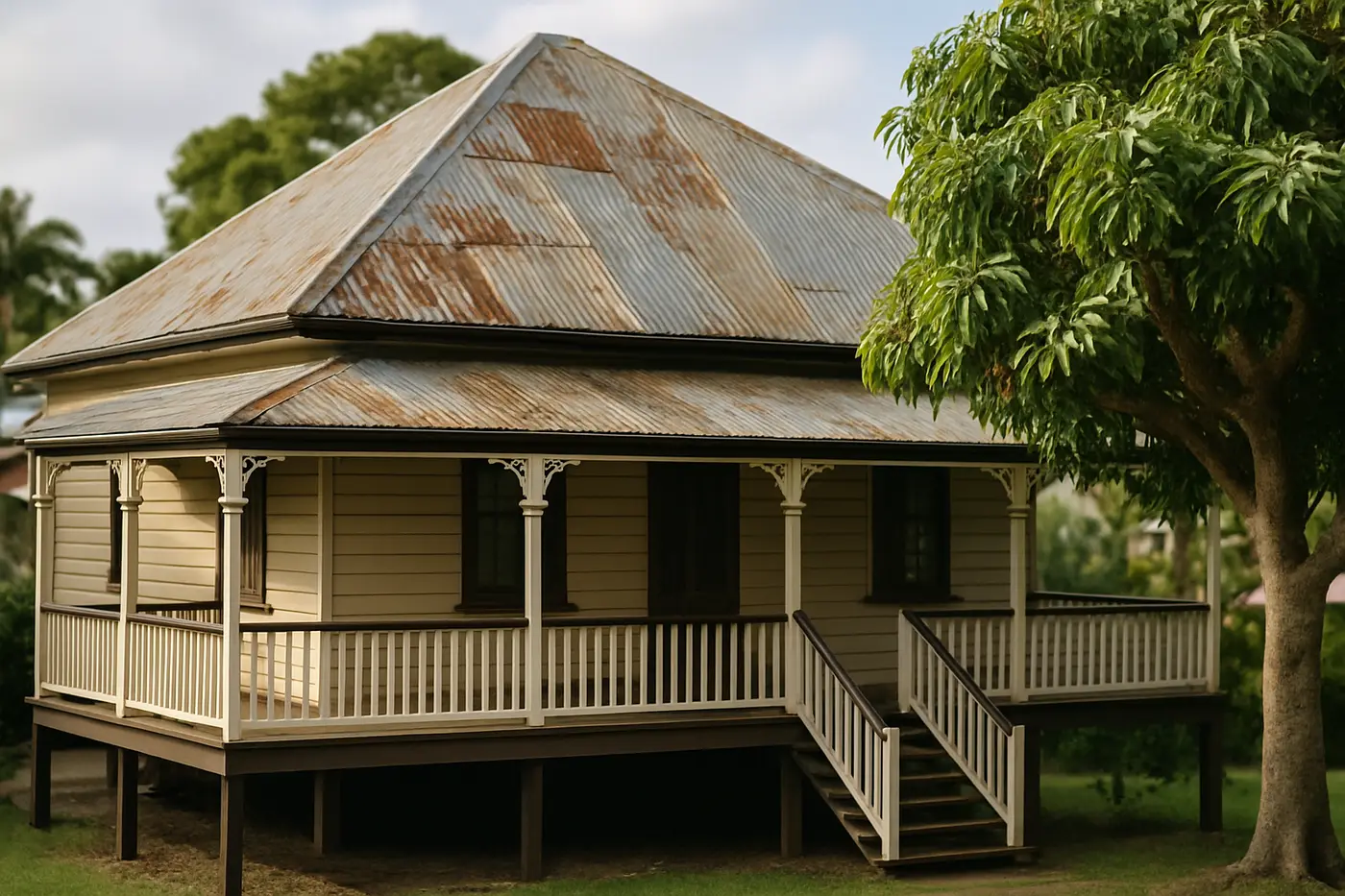
Brisbane’s inner and middle suburbs carry one of the best surviving stocks of timber-and-tin housing in Australia. Paddington, Red Hill, New Farm, West End, Highgate Hill, Woolloongabba, Annerley — street after street of pre-war Queenslanders and workers’ cottages, most of them still wearing corrugated metal roofs at a steep, storm-shedding pitch.
Those roofs were brilliantly suited to the subtropics when they were built. A century on, they fail in predictable ways. This guide covers the specific problems we see on Queenslander roofs across Brisbane, how character overlay rules affect what you can do about them, and how to decide between repair and re-roof.
The Queenslander roof, briefly
The classic pre-war roof is short-sheet galvanised corrugated iron, fixed with lead-head nails to hardwood battens over hardwood rafters, pitched steeply (often 25 to 35 degrees or more on the main roof), with hips, gables, and frequently a bullnose or skillion verandah roof at a much shallower pitch. Chimneys, ridge ventilators and decorative gable work add junctions — and every junction is flashed, usually originally in lead.
Three features drive most of the problems that follow: the age of the original steel, the number of junctions and pitch changes, and the decades of alterations layered on top.
The big five Queenslander roof problems
1. Original corrugated iron at end of life
Galvanised iron of the era commonly delivered 60 to 90 years of service. If your roof is original, it is now 80 to 120 years old. Rust rarely starts in the middle of a sheet — it begins where water sits or where the zinc coating was cut: sheet laps, cut edges, around nail holes, and anywhere leaf litter holds moisture.
The tell-tale progression: surface rust bloom, then rust staining down the sheets after rain, then pinholes you can see from inside the roof space on a bright day. By the pinhole stage, the sheet has lost most of its thickness and patching is temporary at best. Widespread pinholing across multiple sheets is the clearest single signal that roof replacement rather than repair is the right conversation to have.
Many Queenslanders were re-sheeted mid-century. Those roofs bought another 50 or 60 years — which means plenty of “second roofs” in Paddington and Annerley are now failing too.
2. Rusted valleys and box gutters
Valleys — the internal gutters where two roof planes meet — collect the most water, the most leaf litter and the most debris, so they rust out years before the main sheets. On complex Queenslander roofs with multiple hips and gables, valley failure is the number one leak source we find.
Box gutters are worse again. Some Queenslanders, especially those with later additions, have concealed box gutters between roof sections. When a box gutter rusts through, water goes straight into the wall frame or ceiling with nowhere else to go, and the damage is often well advanced before anyone notices a stain.
The good news: valleys and box gutters can usually be replaced independently of the roof sheets. New Colorbond-compatible valley trays under existing iron is a standard metal roof repair job and one of the highest-value repairs an old roof can get.
3. Lead flashings and lead-head nails
Pre-war roofers flashed chimneys, walls and junctions in sheet lead, and fixed sheets with lead-head nails. A hundred years later:
- Lead flashings fatigue, crack and lift. Because lead work is soft and was often dressed into mortar joints, it also pulls loose as old masonry moves. Slow, intermittent leaks around chimneys almost always trace back to flashing, not the chimney itself.
- Lead-head nails loosen as hardwood battens shrink and season. Backed-out nails leave enlarged holes that weep in wind-driven rain, and loose sheets are the first thing Brisbane’s spring storms peel back.
- Lead and drinking water don’t mix. If you harvest rainwater, runoff over old lead work is a reason on its own to modernise flashings.
Modern practice replaces lead with Colorbond flashings and screws sheets down with proper roofing fasteners — routinely done during re-roofing, and worth doing selectively during major repairs.
4. Low-pitch extensions and lean-tos
Almost no Queenslander is untouched. Rear kitchens, sleep-outs, bathrooms under the main roofline and later family-room additions were typically roofed at a fraction of the main roof’s pitch — sometimes almost flat.
Low pitch is where corrugated profiles struggle. Water moves slowly, backs up under end laps in heavy rain, and finds every imperfect flashing at the junction where the addition meets the original house. In a February storm cell dumping 60 millimetres in half an hour, these sections simply cannot shed water fast enough.
Fixes range from re-flashing the junction, to replacing the section in a low-pitch profile designed for it, to lifting the pitch during a renovation. What rarely works is another tube of silicone along the lap.
5. Rust from the inside: condensation and lack of sarking
Original roofs were laid without sarking (reflective foil underlay). Moist air condenses on the underside of cold metal on winter mornings, and decades of that wets battens and quietly rusts sheets from below. It also means any leak drips straight through to the ceiling. A re-roof is the opportunity to add sarking and insulation blanket — one of the biggest comfort upgrades an old Queenslander can get.
Character overlays: what you can and can’t do
Large parts of Paddington, Red Hill, New Farm, West End, Highgate Hill and similar inner suburbs sit under character overlays under Brisbane City Plan, which protect the traditional streetscape of pre-1947 housing. For roofs, the practical effect is usually:
| Work | Typical position in character areas |
|---|---|
| Like-for-like repairs | Fine — repairing or replacing sheets, valleys, flashings in matching profile |
| Re-roof in corrugated steel, traditional colour | Generally acceptable — this is the standard path |
| Change to tiles, or a distinctly modern profile | Likely to conflict with the overlay’s intent on street-facing roofs |
| Adding solar, whirlybirds, skylights | Usually fine, placement may matter on prominent elevations |
The overlay is not a reason to fear re-roofing — thousands of character-listed Queenslanders have been re-roofed in modern Colorbond corrugated profile that looks right at home. It is a reason to use a roofer who works in these suburbs regularly and knows what will and won’t raise issues. Phrase one rule of thumb in your head: keep the profile and pitch, choose a traditional colour, and you’re rarely in trouble.
Repair or re-roof? A practical framework
Lean towards repair when:
- Rust is confined to valleys, gutters, flashings and a handful of sheets
- The roof was re-sheeted in the last 40 years and the steel is fundamentally sound
- You need to stop active leaks now and plan a re-roof in 5–10 years
Lean towards re-roof when:
- Pinhole rust shows across multiple sheets, not just at laps and valleys
- Fixings are failing broadly and sheets lift in wind
- You’re already renovating — scaffolding, access and disruption are shared costs
- You want sarking, insulation and modern flashings in one pass
A full Queenslander re-roof is a significant spend, but it resets the clock for 50-plus years, and it is almost always cheaper than a decade of chasing leaks plus the internal repairs those leaks cause. Our guide to roof restoration covers the middle path for roofs that are sound but tired.
The bottom line for owners
If you own a pre-war Queenslander or workers’ cottage in Brisbane, assume the roof — original or mid-century replacement — is somewhere on the failure curve, and get a proper condition assessment rather than waiting for the ceiling stain. Valleys, box gutters and flashings fail first and are fixable; widespread sheet rust means it’s time to plan properly.
If you’d like a clear, honest read on where your roof sits, book a free roof inspection online and we’ll walk the roof, photograph what we find, and give you a repair-versus-re-roof recommendation you can actually plan around.