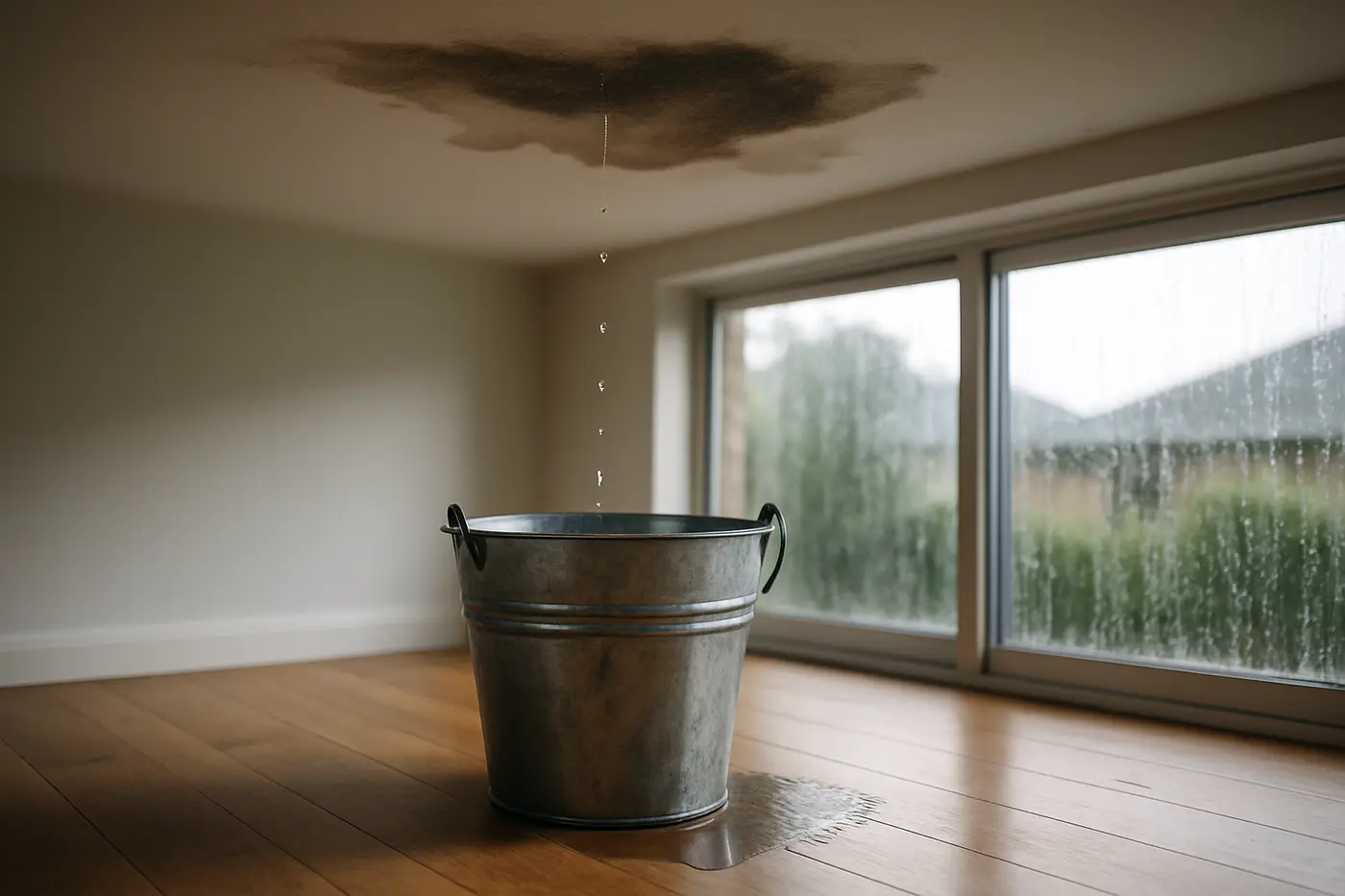
Brisbane’s storm season runs November through March, and the pattern is familiar to anyone who’s lived here more than a year: a stinking hot afternoon, a black-green wall of cloud building over the ranges to the south-west, then twenty minutes of sideways rain, hail, and wind gusts that find every weak point in a roof.
If water is coming through your ceiling right now, the good news is that the first half hour is about containment, not repair — and containment is something you can do safely from inside the house. Here’s the sequence we walk homeowners through every storm season.
Step 1 — Catch the water and protect what’s under it
Get buckets, pots, or plastic storage tubs under every active drip. Put a towel or an old t-shirt in the bottom of each container — it stops the maddening drip noise and, more usefully, stops splash-back spreading water across the floor.
Then widen your view. Water rarely travels straight down. It runs along the underside of rafters and battens and drops out somewhere else, so check adjoining rooms, hallway ceilings, and the tops of built-in wardrobes. A single leak point on the roof can produce three or four drip points inside.
Move what matters: electronics, rugs, books, anything on the floor within a couple of metres of the drips. Drag beds and lounges clear. If a ceiling stain is spreading, assume the wet zone will be twice its current size by the time the storm passes.
Step 2 — Deal with electricity before anything else gets wet
Water and wiring share your ceiling cavity. If water is dripping through or near a light fitting, ceiling fan, or downlight:
- Switch off the light circuit (and the power circuit for that part of the house if you’re unsure) at the switchboard.
- Don’t touch light switches or fittings with wet hands.
- Don’t turn those circuits back on until an electrician or roofer has confirmed the cavity is dry around the fittings.
Downlights are the classic failure point in Brisbane homes — water pools in the recessed housing, and the first sign is often a fitting that flickers or trips the safety switch mid-storm. If your safety switch has already tripped, leave it off for the affected circuit.
Step 3 — If the ceiling is bulging, release the water
A plasterboard ceiling holding a pool of water looks like a bulging blister. Left alone, the whole sheet can let go at once — dumping dozens of litres and a lot of soggy plaster into the room.
Photograph the bulge first (you’ll want it for insurance), put your biggest container underneath, then push a screwdriver or skewer through the lowest point of the bulge. A controlled drain through a small hole is vastly better than a collapsed ceiling, and the patch repair is trivial by comparison.
Step 4 — Do NOT get on the roof
This one is non-negotiable. A wet roof — tile or metal — is treacherous even for professionals with harnesses, and Brisbane storms bring lightning with them. Every storm season, Queensland emergency departments see falls from roofs that happened during or immediately after storms, and some of them are fatal.
There is nothing you can achieve on a wet roof in the rain that justifies the risk. Tarps flap, tiles slide, gutters give way. Wait it out. The water that gets in over the next hour is an insurance line item; a fall is not.
Step 5 — SES or private roofer? Who to call and when
Call the SES on 132 500 if:
- A tree or large branch has come down on the roof
- Part of the roof has lifted or sheets have blown off
- Water is entering faster than you can contain and the storm is ongoing
- The damage is structural or the house feels unsafe
The SES is a volunteer emergency service. They’ll make the situation safe — usually with temporary tarping — but they don’t repair roofs, and during a major event like a supercell they triage the worst damage first, so waits can run to many hours or days.
Call a private roofer when the leak is contained, the storm has passed, or the damage doesn’t meet the emergency threshold. A professional storm damage roof repair team can carry out a proper make-safe — battened-down tarps rather than sandbag-weighted ones — then quote and complete the permanent repair. Private make-safe work is typically claimable on your storm damage insurance claim, so keep every invoice.
Step 6 — Document everything for your insurer
Insurance claims live and die on evidence gathered on the day. Before you clean anything up:
- Photograph every drip point, ceiling stain, and bulge, with something for scale.
- Video the water actively coming in if you safely can — nothing establishes “sudden storm damage” like footage of it happening.
- Photograph damaged contents in place before moving them.
- After the storm, photograph the roof from the ground: displaced tiles, dented gutters, debris, hail on the lawn (hail melts fast — a photo of hailstones next to a coin is gold for a hail claim).
- Note the date and time; the Bureau of Meteorology’s records of the storm cell will back you up.
Lodge the claim promptly — most insurers take storm claims online or by phone the same day — and ask whether they authorise emergency make-safe costs up front. Most do, up to a stated limit.
What happens at the roof inspection
Once the weather clears, the roof needs a proper inspection — from on the roof, not from the driveway. Whether it’s the insurer’s assessor or your own roofer, expect them to check:
- Tile roofs: cracked, chipped, or displaced tiles; fractured ridge capping and pointing; valley irons; sarking condition underneath. Hail cracks in concrete tiles are often hairline and invisible from the ground — see our tile roof repair page for what those repairs involve.
- Metal roofs: hail dents, lifted or fatigued fasteners, sheets strained at the screw line by wind uplift, flashings and ridge caps disturbed by gusts.
- Inside the cavity: wet insulation (it holds water for weeks and breeds mould), water-stained timbers, and the entry point itself — which is often a metre or more uphill from where the drip appeared.
A good roofer will give you a written scope with photos. That document matters twice: it drives the repair quote, and it’s your counterweight if the insurance assessor’s scope misses damage.
After the storm: don’t leave it half-fixed
A tarp is a bandage, not a repair. Brisbane’s storm season delivers storms in clusters — the same trough line that produced Tuesday’s cell often produces Thursday’s — and a tarped roof that survives one follow-up storm may not survive the third. Book the permanent roof repair as soon as your claim allows, and if you’re waiting on an insurer, ask your roofer to re-secure the tarp in the meantime.
And once everything is dry and fixed, put a reminder in your calendar for September: a pre-season inspection catches the cracked tile or rusted screw before the next supercell finds it. If you’d like a professional set of eyes over your roof — before or after a storm — book a free roof inspection online and we’ll give you a written, photographed report of exactly what’s up there.