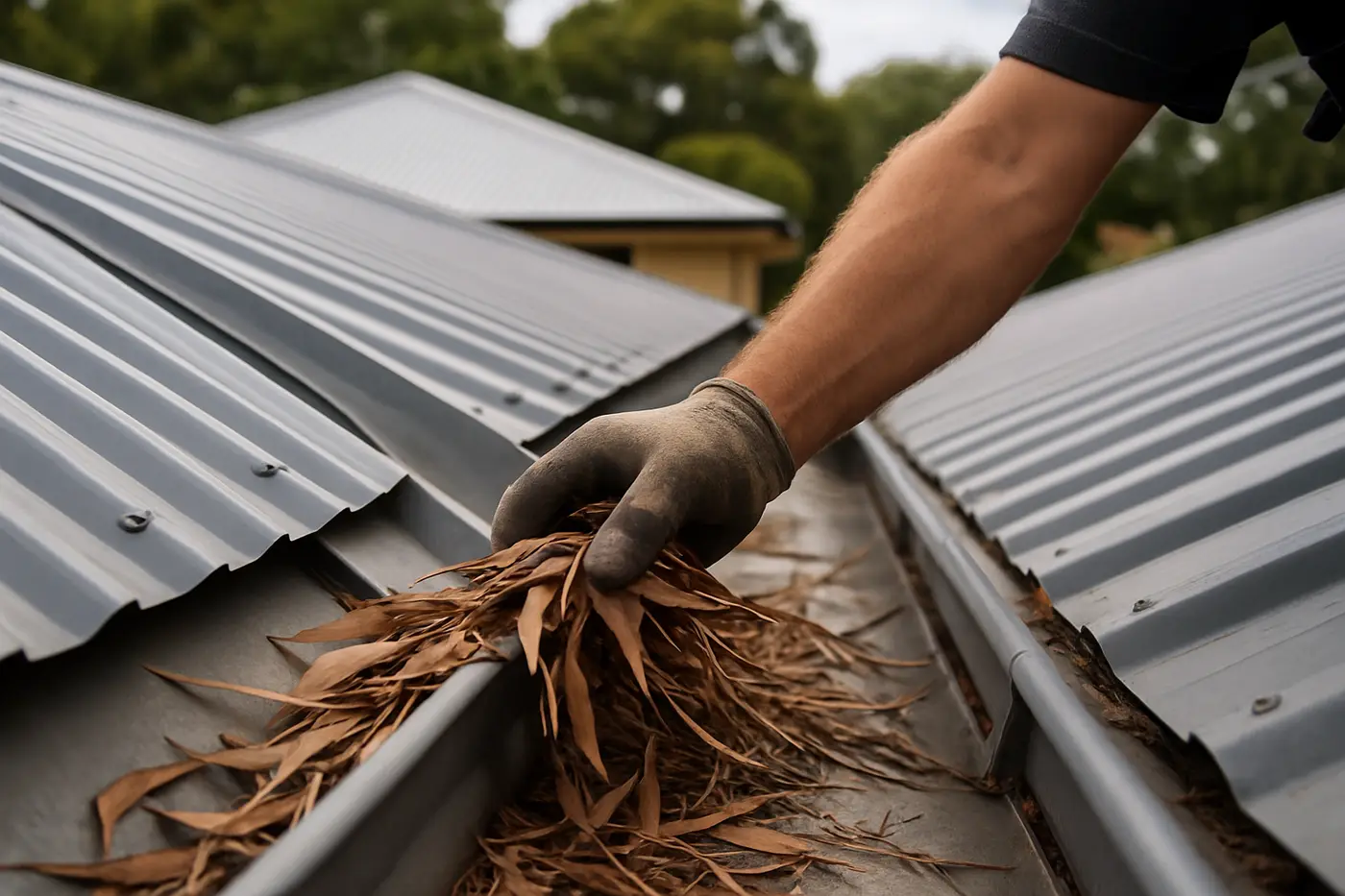
Brisbane roofs don’t wear out evenly through the year — they take their damage in bursts between November and March, and they telegraph almost all of it in advance. A cracked tile in July becomes a ceiling stain in December. A gutter full of jacaranda litter in October becomes a waterfall over the fascia in the first November downpour.
This is the maintenance rhythm we recommend to Brisbane homeowners: two scheduled checks a year keyed to storm season, a defined post-storm routine, and a professional set of eyes every year or two.
The Brisbane maintenance calendar
| When | What | Why then |
|---|---|---|
| Autumn (April-May) | Post-storm-season check | Find and fix what summer actually did |
| Winter (June-August) | Book any repair or restoration work | Dry weather, proper curing, quiet schedules |
| Spring (September-October) | Pre-season check + gutter clean | Roof watertight before the first storm cells |
| After any severe storm/hail | Rapid walk-around + photos | Catch damage while it’s claimable and small |
Autumn: the post-storm-season check
Storm season ends around March. April or May is when you audit the damage while the evidence is fresh:
- Walk the ceiling under every room with a torch at night — water staining shows as tide marks and shadows long before it drips
- From the ground, scan every roof plane for cracked, slipped or missing tiles, or lifted and dented metal sheets
- Check lawns and garden beds below the roofline for pointing rubble or tile fragments — the roof sheds its evidence downward
- Look for granules, silt or mortar chunks in gutters and at downpipe outlets
- Inside the roof space, check for water tracks on timbers and rust stains around nails and screws
Anything found now gets fixed in winter, when the weather cooperates and roof repair schedules are at their quietest of the year.
Spring: the pre-season check
September to mid-October, before the first serious cells build. This is the one that prevents emergency call-outs:
- Clean every gutter, and flush each downpipe with a hose until water runs freely at the outlet
- Clear valleys of leaves and debris — valleys carry double flow in a storm and block first
- Trim branches back from the roofline (rubbing damage plus a constant debris supply)
- Scan ridge caps with binoculars for cracked or missing pointing
- Check flashings around chimneys, skylights, vents and wall junctions for lifting or gaps
- Confirm whirlybirds spin freely and vent cowls are secure
- Take dated photos of every roof plane and the gutters — your pre-season condition record
The four failure points to know by name
Gutters, valleys and downpipes
Brisbane’s storm cells drop enormous volumes in minutes; the roof drainage system is designed for exactly that flow with zero obstruction. A half-blocked gutter overtops backwards into the eaves and wall cavity — the most common “roof leak” we attend isn’t a roof leak at all. Gutters under gum trees or jacarandas may need clearing three or four times a year, not one.
Ridge caps and pointing
The mortar line along your ridges is the tile roof’s consumable. When pointing cracks and lifts, ridge caps loosen, and a loose cap in a 90km/h gust becomes a projectile and an open seam in one. Cracked or crumbling pointing spotted from the ground is the trigger to get a repointing assessment before, not after, summer.
Flashings
Almost every leak that isn’t a blocked gutter is a flashing: the metal junctions around chimneys, skylights, vent pipes and where roof meets wall. Look for lifted edges, cracked or shrunken sealant, and rust lines. Flashing faults are cheap to fix and expensive to ignore, because the water they admit travels along timbers and shows up metres from the entry point.
Sarking, from inside the roof space
Twice a year, stick your head through the manhole with a good torch (mind the insulation and step only on joists if you climb in):
- Daylight anywhere except designed vents means a gap
- Torn, brittle or drooping sarking means the second line of defence is gone — common in homes 30+ years old
- Water staining or rust trails on the sarking or timbers map exactly where the roof is admitting water, even if nothing has reached the ceiling yet
- A musty smell after rain means moisture is getting in and not getting out
Safe-from-the-ground inspection technique
You can see 80% of what matters without leaving the ground:
- Use binoculars and walk the full perimeter slowly — check each roof plane in raking light (early morning or late afternoon shows dents, slipped tiles and lifted sheets that midday light hides)
- Ladder to eave height only for gutter checks: footed on firm ground, 1-in-4 angle, never over-reach, never on a windy day
- Never walk the roof. Tiles crack underfoot (creating the very leaks you’re looking for), metal is treacherous with dew, and single-storey falls are a hospital admission. Roofers carry fall protection for a reason.
- Use your phone’s zoom to photograph anything suspicious for comparison next season — a crack that grows between photos is live movement.
What a professional annual inspection adds
A proper professional inspection — every year for roofs over 15 years old, every two for younger ones — covers what ground-level checks can’t:
- Roof-level examination of every ridge, valley, flashing and penetration
- Fastener condition across metal roofs (rust rings, perished washers)
- Drummy-bedding and cracked-tile checks by hand, plane by plane
- Roof cavity inspection: sarking, timbers, insulation, ventilation
- Gutter fall and rust condition, downpipe discharge
- A written report with photos and a prioritised repair list
That last item is half the value. A documented condition report gives you a maintenance history, a baseline for storm claims, and protection against scare-quotes from door-knockers after every hail event. If a roof has been neglected for years, a report is also the honest starting point for deciding between repairs and a full restoration.
Record-keeping for insurance
Queensland insurers pay storm claims — but they scrutinise maintenance, and policies exclude damage from “wear and tear or lack of maintenance.” Your file should hold:
- Dated photos of every roof plane and gutter run, refreshed each spring
- Invoices for gutter cleans, repairs, repointing, inspections
- Inspection reports with photos
- Post-storm photos taken before any temporary repairs, plus receipts for tarps or make-safe work (usually claimable)
When hail hits, the homeowner with a spring photo set and an inspection report from March gets assessed and paid while the homeowner with nothing argues about whether the damage was pre-existing.
Put it on the calendar
None of this is complicated — it fails only because it’s nobody’s job. Set two recurring reminders now: Anzac Day weekend for the autumn check, the October long weekend for the spring one. An hour each, twice a year, plus a professional look every year or two.
If it’s been more than a couple of years since anyone qualified looked at your roof — or this autumn’s check turned up something you’re not sure about — book a free roof inspection online and start the file with a proper photo report.