If you’ve been told your roof needs “rebedding and repointing” and nodded along without knowing what either word means, you’re in the majority. They’re the two least-understood line items in Brisbane roofing — and because the work is invisible from the ground, they’re also where vague quotes and skipped steps hide most easily.
Here’s what the work actually is, what it costs in Brisbane in 2026, and how to read a quote properly.
Bedding vs pointing: two jobs, not one
Every ridge, hip and gable line on a tile roof is finished with capping tiles. Two materials hold them there:
- Bedding is the structural layer — a sand-cement mortar bed the caps sit in. It does the holding.
- Pointing is the weatherproof finish applied over the exposed edge of the bedding. Modern pointing is a flexible acrylic compound; it seals the joint and locks the cap down. It does the sealing.
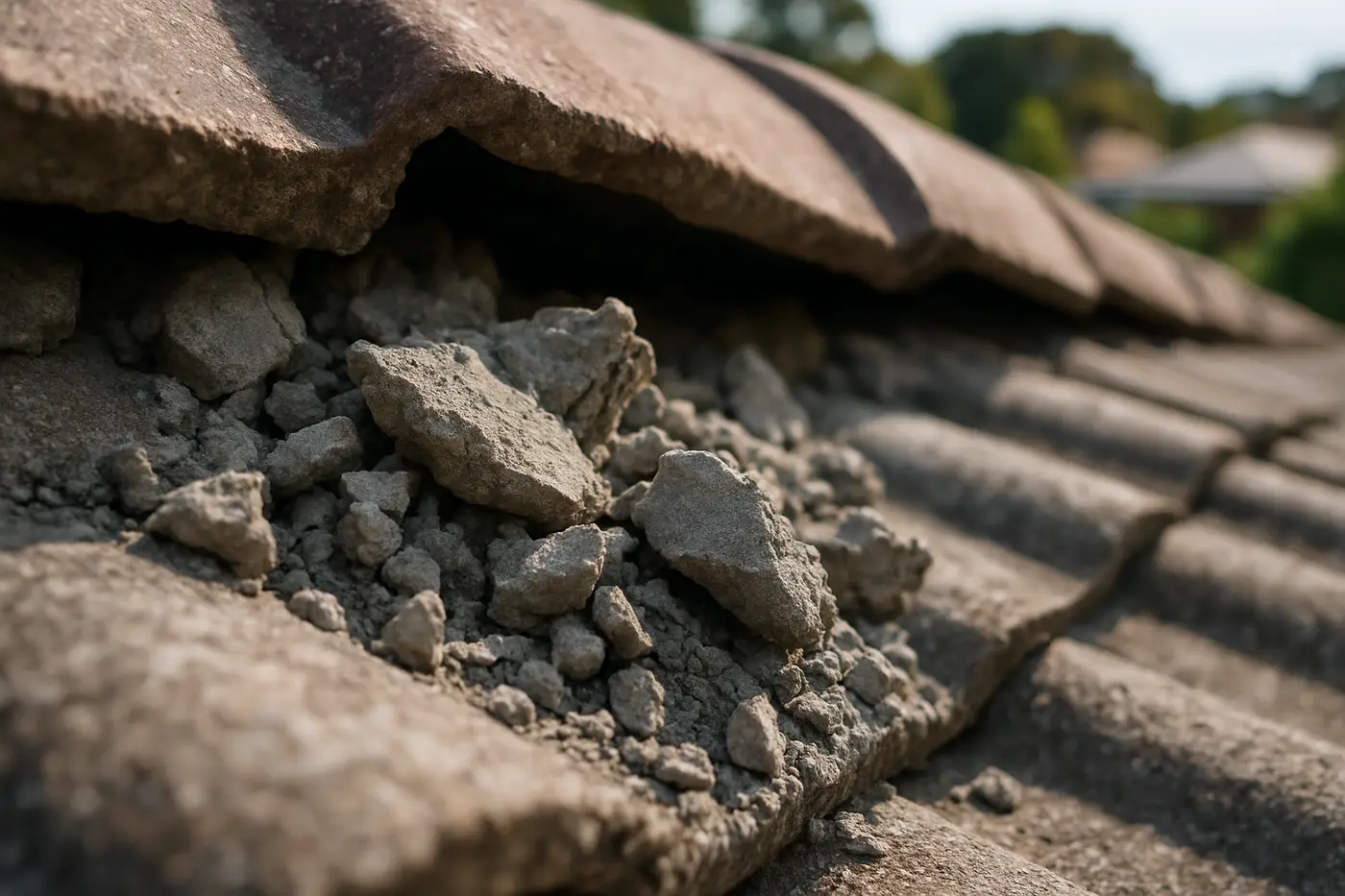
The distinction matters because the two fail differently and are priced differently. Pointing that’s cracked and flaking over a still-solid bed is a repoint — the cheaper job. Bedding that’s cracked through, crumbling into the gutters, or letting caps rock underhand needs a rebed: caps lifted off, old mortar chipped out, fresh bed laid, caps reset, then new pointing over the top. Pointing over failed bedding is painting over rot — it looks fixed for a year or two, then the movement underneath cracks it open again.
What it costs in Brisbane in 2026
Repointing and rebedding in Brisbane is quoted per lineal metre of ridge, then usually presented as a whole-job figure:
| Scope | Typical 2026 price | Notes |
|---|---|---|
| Repointing only (per metre, flexible compound) | $28-$50/m | Over sound existing bedding |
| Rebed + repoint (per metre) | $55-$90/m | Caps lifted, new bed, new pointing |
| Typical whole-roof job (mixed rebed/repoint) | $1,500-$3,500 | The most common Brisbane scenario |
| Full rebed of all ridges, large/complex roof | $3,500-$6,000 | Hip roofs with 40+ ridge metres |
| Isolated storm repair (few metres + tile swaps) | $350-$900 | Standard repair call-out territory |
Where your job lands depends on three things: total ridge metres, the rebed-to-repoint ratio, and access. A simple gable roof might carry 15 metres of ridge; a hipped 70s brick home in Carindale or Aspley can carry 40-plus. Two-storey homes and steep pitches add edge protection and time.
Note the threshold that matters in Queensland: once a job exceeds $3,300 including materials, the contractor legally must hold a QBCC licence. Plenty of full rebeds cross that line, so check the licence number on the quote against the QBCC register.
Why 60s-80s Brisbane roofs are the classic case
Brisbane’s post-war expansion — Stafford, Mount Gravatt, Wynnum, Aspley, Inala, and the 70s-80s estates beyond them — was roofed overwhelmingly in concrete tile, bedded in rigid sand-cement mortar. Flexible pointing didn’t exist; the mortar was both structure and seal.
Rigid mortar has a design life, and Brisbane is hard on it: 40-degree summer roof surfaces, sharp cool changes, cyclonic-fringe storm cells and the constant slight movement of timber-framed houses. After four to six decades the mortar cracks, powders and lets go. If your house was built between roughly 1960 and 1985 and the ridge lines have never been redone, assume they’re due — the evidence is usually already in your gutters as grey mortar crumbs.
The good news: the tiles themselves often have plenty of life left. Concrete tiles can serve 50-60 years even when the mortar holding the caps gave up two decades earlier. That’s why rebedding and repointing is a core stage of a full roof restoration rather than a reason to replace the roof — and why doing it as a standalone job now doesn’t waste money if you restore later. Any roofer quoting a restoration should credit ridge work already done properly.
How quotes are structured (and how to compare them)
A proper repointing/rebedding quote should tell you:
- Total ridge metres, and how many of those metres are rebed versus repoint-only. This is the single biggest price driver, and “allow for rebedding as required” without a quantity is how disputes start.
- The pointing product — a named flexible pointing compound and colour, not “premium pointing”.
- Broken tile allowance — caps and adjacent tiles crack during the work on old roofs; a fair quote includes a stated number of replacements.
- Cleanup and disposal — old mortar comes off the roof in serious quantity. Gutters should be cleared of debris as part of the job.
- Warranty — quality flexible pointing carries long manufacturer ratings; workmanship warranties of 5-10 years are reasonable for this work.
Comparing quotes is only meaningful metre-for-metre and scope-for-scope. A $1,600 quote that repoints over failing bedding is not cheaper than a $2,800 quote that rebeds the failed sections — it’s a different, and worse, job.
The storm season angle
Failed bedding isn’t a cosmetic problem in Brisbane; it’s a wind problem. Ridge caps with crumbled beds are the first thing a November storm cell lifts, and once one cap goes, water pours straight into the ridge line for the rest of the season. It’s also an awkward insurance conversation: insurers cover sudden storm damage, but they routinely push back on claims where the underlying failure was long-term maintenance — and decades-old crumbled bedding is exactly what their assessors look for.
Getting ridge work done in the April-October dry season costs the same, schedules easier, and means you’re not competing with half of Brisbane for emergency roof repairs in December.
Find out what your ridges actually need
You can’t price this work from the ground, and neither can anyone else — the split between rebed and repoint is only visible up close. A free roof inspection with a photo report will show you every failed section, give you the metre counts, and put a real number on the job. Book a free roof inspection online before storm season and know exactly where your ridge capping stands.