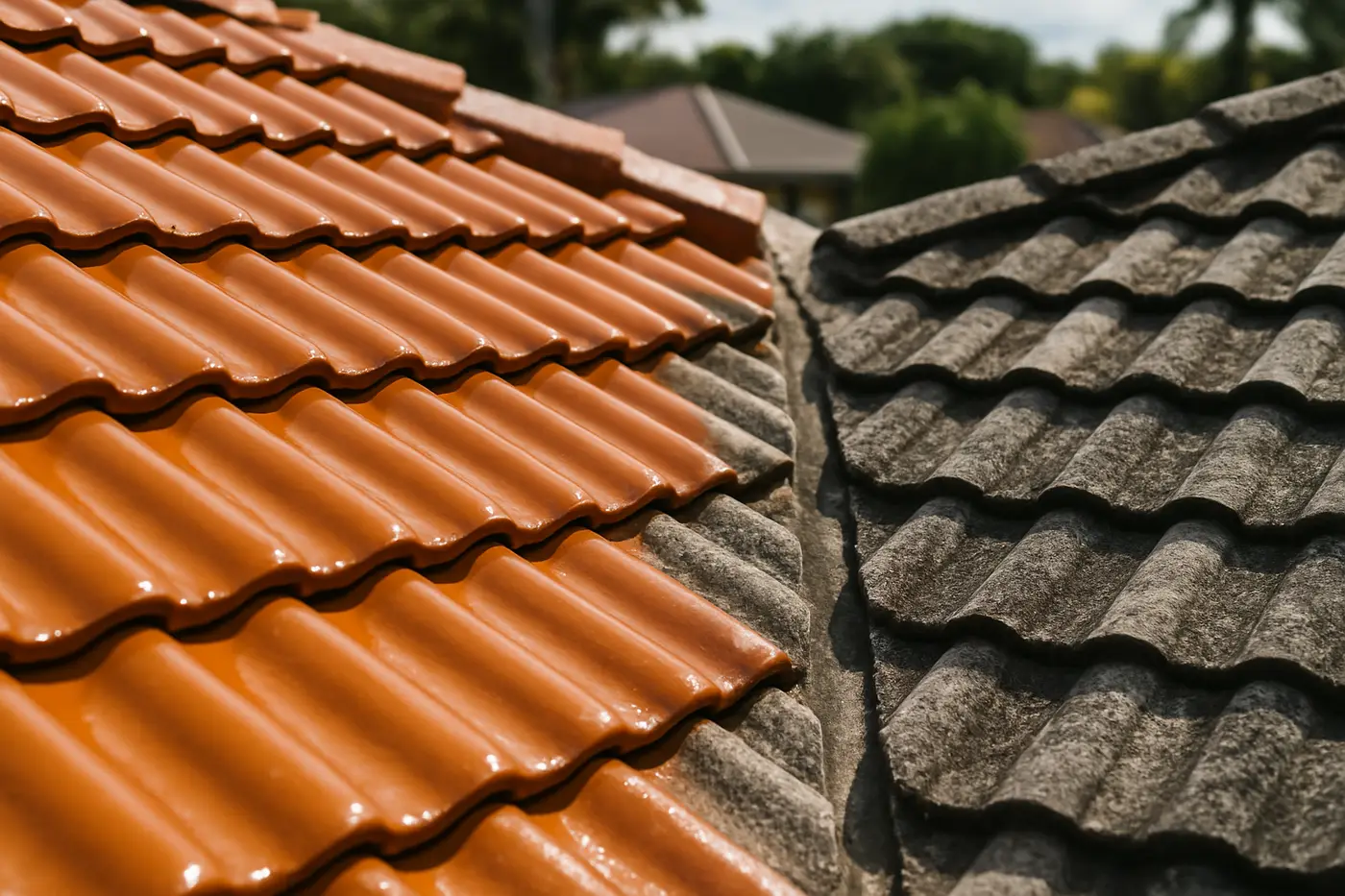
Drive through Brisbane’s middle-ring suburbs — Aspley, Chermside, Mount Gravatt, Sunnybank, Carindale — and you’re looking at one of the biggest concentrations of tiled roofs in the country. Most went on between the 1950s and the 1990s, and they split into two materials that look superficially similar and age completely differently: terracotta and concrete.
Which one is on your roof changes what goes wrong, what repairs make sense, whether restoration is worthwhile, and what a fair quote looks like. Here’s the full comparison for Brisbane conditions.
First: which one do you have?
Quick identification checks, best done with a broken tile or from the roof edge:
| Check | Terracotta | Concrete |
|---|---|---|
| Broken edge / underside | Orange-red ceramic right through | Grey cement core under a coloured skin |
| Surface | Fired glaze or satin ceramic finish | Painted/pigmented surface, often eroded or lichen-spotted |
| Tap test | Higher, ringing note | Dull thud |
| Age of home | Common pre-war to 1960s, and on premium builds since | Dominant from the 1960s through the 1990s |
| Typical profiles | Marseille/French patterns, smaller format | Larger flat or low-profile shapes |
Era is a strong clue in Brisbane. Ashgrovian bungalows and inter-war homes in Ashgrove, Coorparoo and Camp Hill often carry original terracotta. The brick-and-tile waves through Aspley, Sunnybank, Carindale, Wishart and Albany Creek are overwhelmingly concrete.
Lifespan: body versus surface
The single most useful way to think about the difference:
- Terracotta ages in the glaze. The fired ceramic body is extremely durable — 75-plus years is routine, and plenty of pre-war Brisbane terracotta is still weatherproof. When terracotta does decline, it’s usually the glaze crazing and the tile becoming porous, or individual tiles cracking, rather than the whole roof failing at once.
- Concrete ages at the surface. The cement body is quoted at 40 to 60 years, but the coloured surface erodes long before that. Brisbane’s UV strips the pigmented coating over 15 to 30 years, exposing grey cement; older tiles then start fretting — the surface goes friable, sheds sandy grit into the gutters, and edges crumble. Fretting is the beginning of the end for the tile itself.
Either way, the roof’s weak point is often not the tiles at all. The mortar bedding and pointing holding ridge and hip cappings fails every 20 to 30 years on both materials, and failed pointing causes more leaks and storm damage than tile breakage does. If your cappings are loose or the pointing is cracked and falling out, that’s a rebedding job — see our tile roof repair service for what’s involved.
Colour and fade
- Terracotta: the colour is the material. Glazed terracotta holds its colour for the life of the tile — a 70-year-old Marseille roof in Coorparoo is still recognisably terracotta-orange. Unglazed terracotta mellows but doesn’t go patchy.
- Concrete: fade is the defining ageing symptom. Expect visible dulling within 10–15 years of manufacture and a blotchy, part-grey appearance by 25–30. It’s cosmetic at first, but bare cement absorbs more water, grows more moss and lichen, and deteriorates faster once exposed.
This is why the classic Brisbane restoration candidate is a structurally sound but faded concrete roof — and why repainting terracotta is usually a mistake (paint doesn’t bond well to glaze and looks worse when it peels).
Weight
Both are heavy roofs — that’s why tile-framed houses have closer rafter and batten spacing than metal-roofed ones. Concrete is the heavier of the two, typically in the region of 45–55 kg per square metre laid, with terracotta usually a little lighter depending on profile. In practice:
- Swapping terracotta for concrete (or vice versa) is normally fine structurally, but it should still be checked.
- Swapping tile for lightweight metal removes several tonnes from the frame — fine, but the roof needs new battens and often affects bracing assumptions, which is a roof replacement design conversation, not a like-for-like swap.
Repairs and matching discontinued profiles
Individual tile replacement is routine on both materials — the trick is matching, because most of the profiles on Brisbane roofs are long discontinued.
- Second-hand tile market: Brisbane roof strippers and tile recyclers hold big stocks of common discontinued concrete and terracotta profiles. Sourcing a pallet of matching salvaged tiles is normal practice.
- Colour matching: a 30-year-old faded tile never matches a fresh or differently weathered donor tile. Good roofers harvest sound tiles from hidden planes (behind the ridge line, over the garage) for visible repairs and put mismatches out of sight.
- Genuinely unobtainable profiles: options are re-tiling a single plane, adapting a near-compatible profile with care at junctions, or accepting that the next major spend is a re-roof.
One caution that applies to both materials: walking a tile roof badly breaks more tiles than it fixes. Concrete tiles crack under a misplaced boot, and old brittle terracotta even more so. Roof access is half the skill in tile repair.
Restoration suitability: the big difference
This is where the two materials properly diverge.
Concrete tiles are the ideal restoration candidate. The standard roof restoration process — pressure clean, replace broken tiles, rebed and repoint ridges, then prime and apply two membrane top coats — essentially rebuilds the sacrificial surface that concrete loses to UV. Done properly on a sound roof, it resets appearance and weather resistance for another 10–15 years at a fraction of replacement cost. The exception: heavily fretted tiles are past coating. Membrane over crumbling cement fails early, and an honest assessor will tell you when a roof has crossed that line.
Terracotta restoration is repair-and-conserve, not recoat. Clean carefully (aggressive pressure washing can damage aged glaze), replace cracked tiles with matched salvage, rebed and repoint the ridges — and leave the glazed surface alone. A sound terracotta roof doesn’t need paint, and doesn’t want it.
Cost differences at a glance
Indicative Brisbane patterns rather than quotes:
- Spot repairs and tile swaps: similar cost for both materials; salvage terracotta tiles for rare profiles can cost more per tile to source.
- Rebedding and repointing: priced per metre of ridge/hip, essentially identical for both.
- Full restoration: concrete restorations include the paint system, so they cost more than a terracotta clean-and-repair — but deliver a bigger visual transformation.
- New material: new terracotta costs significantly more than new concrete per square metre, which is why concrete dominated volume building from the 1960s on, and why original terracotta is seen as a premium feature worth preserving.
The bottom line
Terracotta is the longer-lived, colour-fast, premium material — maintain its ridges and replace the odd cracked tile, and it can outlast the mortgage. Concrete is the workhorse — it fades and its surface erodes, but it responds brilliantly to restoration right up until fretting sets in.
Not sure which you have, or whether yours is a repair, restore or replace situation? Book a free roof inspection online and we’ll identify the tile, check the bedding and pointing, and give you a straight answer with photos to back it up.