How we fix it
About this service in Brisbane
Metal roofs suit Brisbane. Colorbond and corrugated iron shed our summer downpours fast, shrug off most hail that would crack tiles, and weigh little enough for the timber-framed Queenslanders that still make up a huge share of the city’s housing stock. But metal roofs fail in their own predictable ways — and almost all of them start small, cheap and fixable.
The faults we see most on Brisbane metal roofs
Rusted roof screws and perished seals
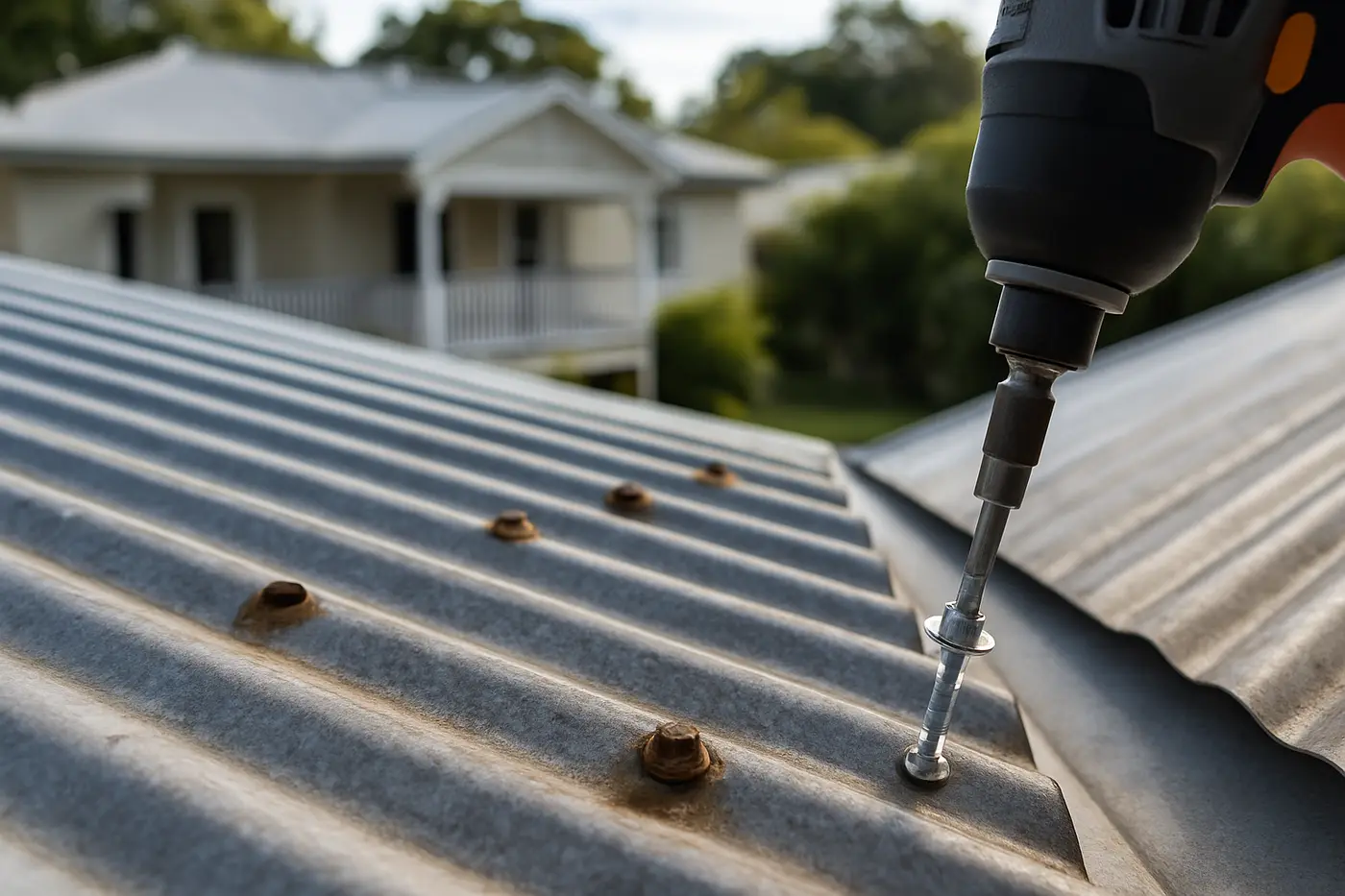
This is the number one call-out. Every roof screw has a neoprene washer sealing the hole it passes through. Queensland UV cooks those washers, typically somewhere between year 15 and year 25. Once the seal goes, water tracks down the screw shank into the batten, the screw rusts, and the hole enlarges. Multiply that by the 1,500-3,000 fasteners on an average roof and you have a roof that leaks in a dozen places at once and — worse — has lost much of its hold-down strength before the next storm season.
A full screw replacement with Class 4 corrosion-rated fasteners is one of the best-value repairs in roofing. It re-seals every penetration and re-anchors the sheets in one pass.
Lifted sheets after storms
When a November-to-March storm cell rolls through and a sheet lifts, the sheet is usually the symptom, not the cause. Wind got under an edge because fasteners were rusted, under-driven or too few. We refix or replace the lifted sheet, then check and refix the surrounding field — otherwise the next blow just picks the seam apart again. A sheet that creased as it lifted gets replaced, not screwed back down; a crease is a permanent weak line.
Valley and box gutter rust — the Queenslander special
Older homes in Ashgrove, Paddington, Wynnum and across the inner and middle rings often have box gutters: internal gutters running between roof planes, hidden from the street. Water sits in them, debris collects, and they rust from the inside out. Because they discharge inside the roof line, a failed box gutter doesn’t drip off the eaves — it pours into the wall cavity or ceiling. If your ceiling stains appear only after heavy rain and sit near the middle of the house rather than the edges, a valley or box gutter is the first suspect.
Light surface rust can be treated and sealed with a reinforced liquid membrane. Perforated gutters need the metal replaced, with adjoining sheets lifted to build in proper falls and overflow provisions. It is fiddlier than eaves guttering, and quotes reflect that — but a properly replaced box gutter is a decades-long fix.
Laps, flashings and penetrations
Every place a metal roof changes direction or something pokes through it — sheet laps, ridge cappings, chimney and skylight flashings, plumbing vents, whirlybirds — is a designed joint that relies on cover, fall and sealant. Sealants age; flashings work loose; whirlybirds seize and leak around their bases. These repairs are quick and cheap, and catching them early is the difference between a $400 reseal and a replastered ceiling.
Salt air near Moreton Bay
If you live in Wynnum, Manly, Boondall or anywhere within a kilometre or two of the bay, your roof lives a harder life. Salt settles on the metal between rains and accelerates corrosion, especially in “unwashed” zones — the sheet tops under eaves and flashings that rain never rinses clean. Cut sheet ends and fastener heads go first.
That doesn’t mean bayside metal roofs are a bad idea; it means they need inspections more often, marine-appropriate material choices when sheets are replaced, and honest attention to the sheltered areas most people never look at. Our inspection reports flag salt-affected zones specifically for bayside homes.
Repair the sheets or re-roof? An honest framework
We get asked this on almost every job, so here’s the same framework we use on the roof:
- Repair when rust is localised (a valley line, a shaded section, isolated sheets), the fasteners are the main failure, and the underside of the sheets is still clean. Expect the repair to buy 10-15 years or more.
- Think hard when the roof has been patched more than twice before, or corrosion is showing at multiple laps and cut ends. Repairs still work, but budget for a re-roof within 5-10 years.
- Re-roof when broad areas of sheeting are corroding, you can see pinholes of daylight from inside the cavity, or rust is coming through from the underside. Paying repair prices annually on a roof at end-of-life is the most expensive option of all.
We put both numbers in the written report — the repair scope and a re-roof estimate — so you’re deciding with real figures rather than a salesman’s urgency.
What a repair visit looks like
Book a free inspection and we walk the entire roof: every penetration, lap, valley and flashing, plus a look inside the roof cavity where access allows. You get a photo report and an itemised quote separating must-do, should-do and cosmetic. Most repairs are completed in a single day. All drill swarf gets swept off the roof before we leave — those little steel filings rust within weeks and stain new work, and leaving them behind is the mark of a rushed job.
Everything is documented with before-and-after photos and covered by a written workmanship warranty. And because Queensland law requires a QBCC licence for roofing work over $3,300, you can and should check any roofer’s licence on the QBCC register before work starts — ours included.
If your screws are bleeding rust, your sheets are drumming in the wind, or a ceiling stain keeps growing every time it storms, get a quote online or book a free inspection. Small metal roof problems stay small for exactly one storm season — the Brisbane summer finds every weak point eventually.