How we fix it
About this service in Brisbane
Brisbane roofs cop a workload most Australian roofs never see. Six months of the year they bake; from November through March they get hammered by afternoon storms that arrive fast, dump 30-50mm in an hour and leave. The November 2014 hailstorm — still one of the costliest insurance events in Queensland’s history — put holes in roofs from the CBD to the bayside, and plenty of those roofs are only now showing the slow damage that wasn’t obvious at the time.
That’s the pattern with most roof repairs in Brisbane: the failure is sudden, but the cause rarely is. A tile cracked by hail two seasons ago finally lets water past the sarking. Pointing that’s been powdering for a decade lets a ridge cap shift in one big blow. Roofing screws rust quietly for years, then a storm gets under a loose sheet edge.
The repairs we do most in Brisbane
Leak detection and repair. The single most common call. Water rarely drips straight down — it tracks along battens, rafters and sarking before it finds the ceiling, so the stain in your hallway can be metres from the entry point. We trace leaks from both sides: on the roof and inside the ceiling cavity, with photos of what we find. Guess-and-silicone is how leaks come back; tracing is how they stay fixed.
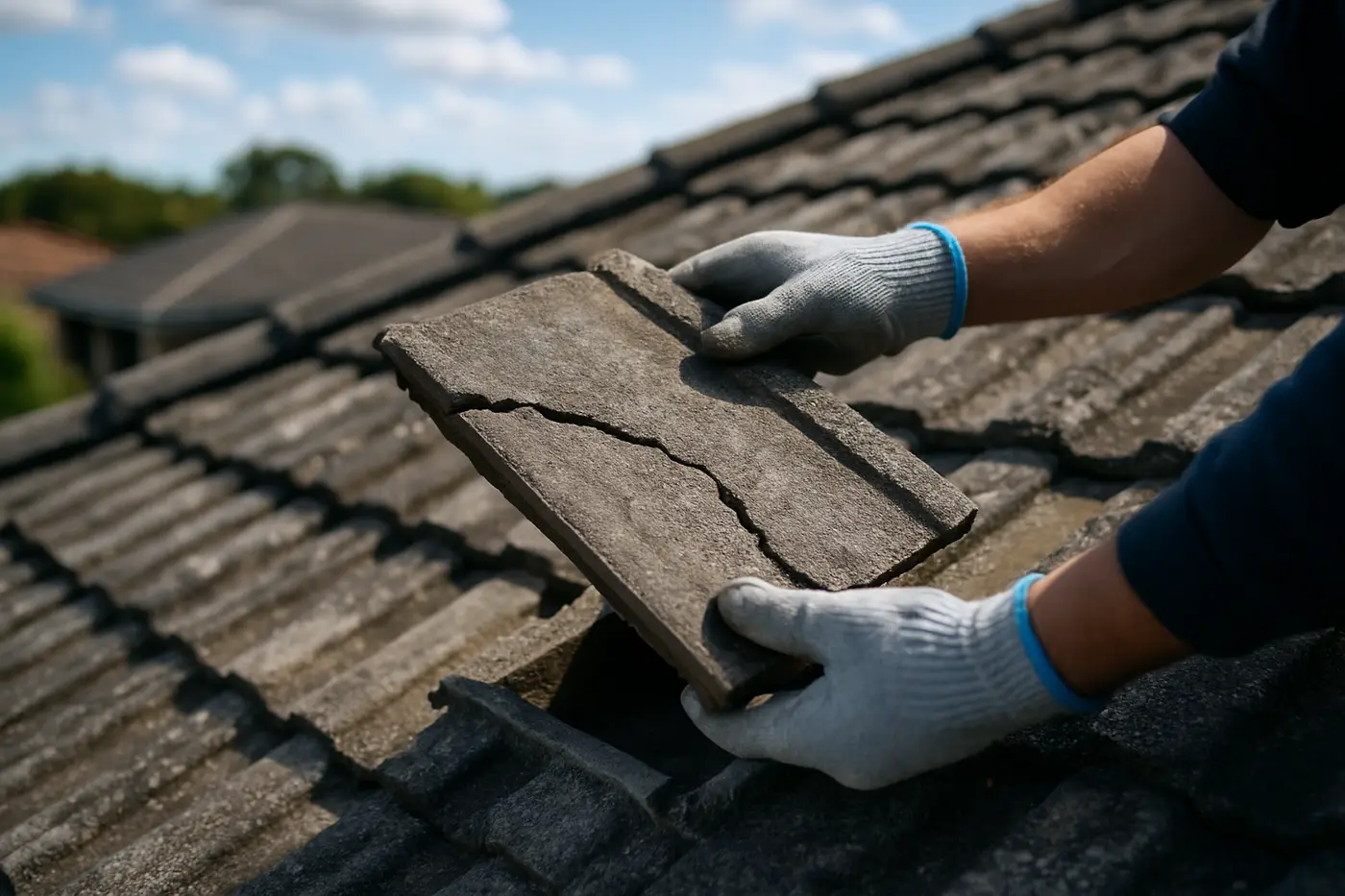
Cracked, slipped and broken tiles. Brisbane’s brick-and-tile belt — the post-war and 1960s-80s suburbs like Sunnybank, Aspley, Carindale and Tingalpa — runs mostly on concrete tiles that are now 40-60 years old. Individual tiles crack from hail, foot traffic (often a previous tradesperson’s), and plain age. One cracked tile is a cheap fix. Left alone, it soaks the sarking below, and sarking is what actually keeps the water out of your ceiling.
Rusted screws and sheet sections. Metal roofs fail at their fixings first. Original screws on older Colorbond and galvanised roofs rust at the head, the rubber seal perishes, and every screw becomes a small hole. We replace with Class 4 corrosion-rated fasteners — the correct spec for Brisbane’s coastal-adjacent air, especially bayside suburbs like Wynnum and Boondall. Sheets that have rusted through at the laps get replaced, not patched.
Flashing and valley irons. Valleys carry more water than any other part of the roof, and galvanised valley irons from the 60s and 70s are at or past the end of their life across most of Brisbane. A rusted-through valley is the classic “only leaks in heavy rain” culprit. Flashings around chimneys, skylights and wall junctions fail the same way — slowly, then suddenly.
Gutter overflows at the roofline. Overflowing gutters push water back under the roof edge and into the eaves. Sometimes it’s just leaf load (anywhere near gums — The Gap, Kenmore, Ashgrove); sometimes the gutter fall is wrong or the box gutter is undersized for Brisbane rain intensity. We fix the roofline side and tell you honestly if the gutters themselves are the problem.
Emergency make-safe. When a storm opens a roof, the first job is stopping water, not perfecting the repair. We tarp, secure loose sheets and tiles, photograph the damage for your insurer, and quote the permanent repair separately. Insurers expect make-safe to happen quickly — you don’t need claim approval before protecting your home from further damage.
Queenslanders, ashgrovians and brick-and-tile: era matters
How we repair your roof depends heavily on when the house was built.
Pre-war Queenslanders and workers cottages (Paddington, West End, New Farm and the inner ring) mostly carry corrugated metal — sometimes original galvanised iron over 80 years old. Repairs here are about matching profiles, dealing with brittle old sheets that can’t take much foot traffic, and being careful around lead-headed nails and old flashings.
Interwar ashgrovians and bungalows often carry terracotta tiles. Terracotta lasts extraordinarily well but the original profiles can be discontinued, so repairs lean on salvage stock and smart tile-shuffling — moving originals to visible areas and putting near-matches where nobody looks.
Post-war and 60s-80s brick-and-tile is concrete tile country, and the common failures are predictable: perished ridge pointing, cracked tiles, dead valley irons. These roofs are also the main candidates for full restoration when the damage is widespread rather than local.
Pre-1990 roofs of any type may involve asbestos — in old “super six” sheeting, eave linings or flashings. We don’t disturb suspected asbestos during a repair; it gets identified, and removal is handled under Queensland’s licensing rules.
Repair, restore or replace?
An honest roofer should tell you which one you actually need, because the economics are different at each level.
- Repair when the damage is local and the rest of the roof is sound. A cracked tile, one bad flashing, a single rusted valley. Most jobs.
- Restore when problems are widespread but the structure is good — perished pointing on every ridge, dozens of tired tiles, surface rust across a metal roof. Patching one spot just relocates the next leak.
- Replace when the roof is at end of life: rust through multiple sheets, tiles that crack underfoot, or structural sag. See our roof replacement page for what that involves.
The free inspection settles it. You get photos of every issue we find and a written recommendation — if it’s a $400 repair, that’s what we’ll quote, and the report is yours either way.
Before the next storm season
The cheapest roof repair is the one done in winter. Brisbane’s dry season (roughly May to October) is when access is easy, trades aren’t storm-swamped, and small problems haven’t yet become ceiling replacements. If your roof hasn’t been looked at since before the last storm season, book a free inspection now — the photo report alone tells you exactly where your roof stands, and if it’s fine, we’ll tell you that too.
Water coming in right now? Get a quote online and mark it urgent, keep buckets under active drips, kill power to affected circuits if water is near fittings, and stay off the roof. Make-safe is our job, and it’s priority-booked all storm season.