How we fix it
About this service in Brisbane
There’s a point in every roof’s life where the next repair is money down the drain. Tiles that crack when a roofer walks the standard paths. Metal with corrosion holes, not just surface rust. A leak history where every storm season finds a new entry point because the whole surface is at end of life. When a roof reaches that stage, coatings and patches just reschedule the problem — replacement is the honest recommendation, and in Brisbane it’s a bigger share of our work than most homeowners expect, because so much of the city’s housing stock went up in two or three big waves that are now ageing together.
The three replacement jobs we do in Brisbane
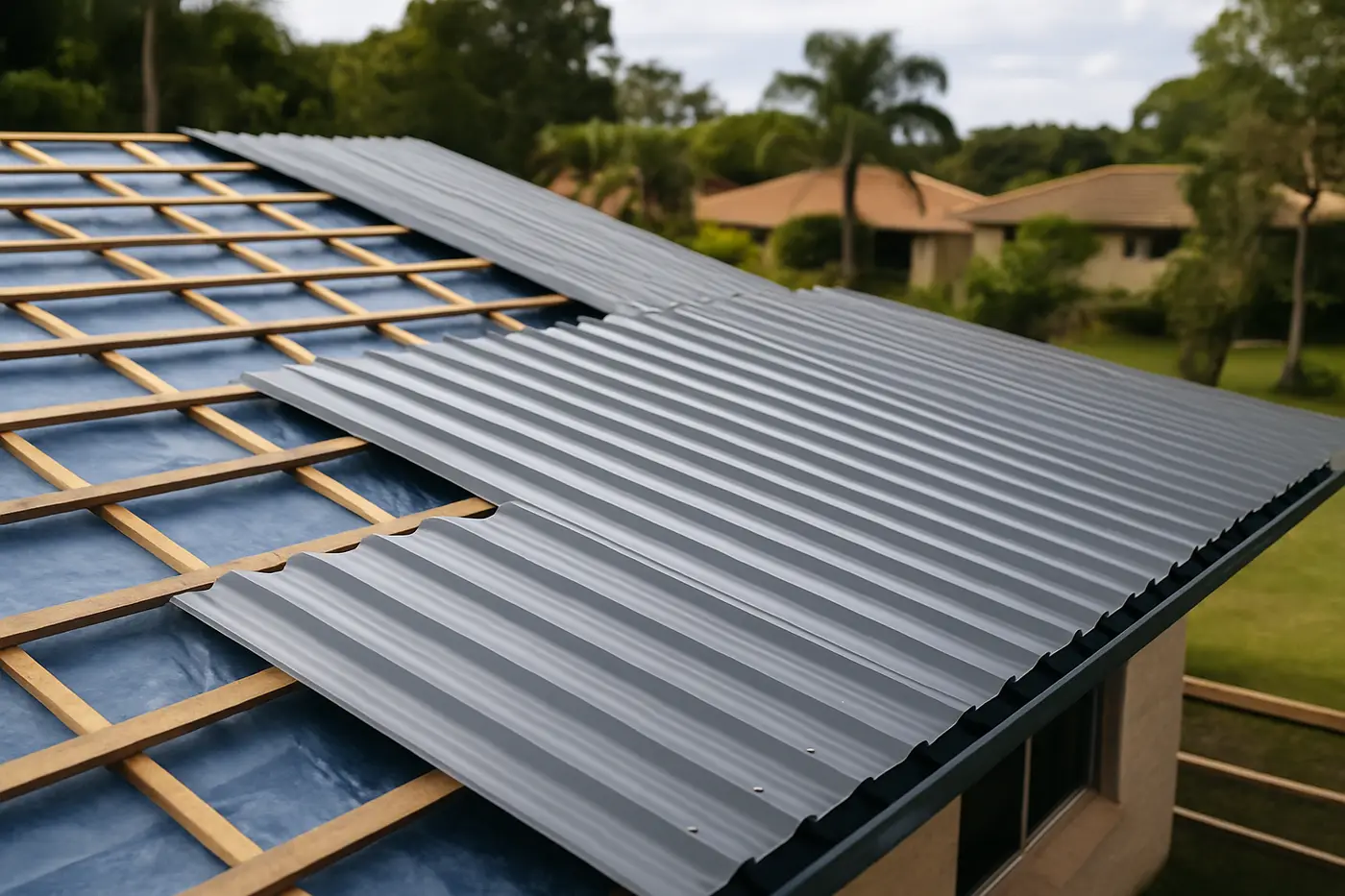
Tile-to-Colorbond conversions. The most requested replacement in the city. Brisbane’s post-war and 60s-80s brick-and-tile suburbs are carrying concrete tile roofs at 50-60 years old, and many owners take the replacement moment to switch to Colorbond steel. The case is practical: steel weighs around a tenth of concrete tile, which takes literal tonnes off an ageing timber frame; it handles hail impact better than brittle old tiles (a lesson the November 2014 hailstorm taught tens of thousands of Brisbane roofs); and it’s lower-maintenance for the next several decades. The conversion involves stripping tiles, checking and usually replacing battens at metal-roof spacings, laying new sarking with an insulation blanket, then sheeting. Rain noise — the traditional objection — is mostly a solved problem with the blanket under the sheets.
Like-for-like re-roofs. Metal-for-metal on Queenslanders and post-war homes, or tile-for-tile where the owner prefers it or the streetscape calls for it. On pre-war homes across New Farm, West End and Paddington, that often means replacing 80-year-old galvanised iron with new Colorbond in a traditional corrugated profile, keeping the roofline the house was built with. Everything under the surface is renewed at the same time: sarking (most old Brisbane roofs have none), flashings, valleys, ridge capping, and any battens that don’t meet current wind-load fixing requirements.
Asbestos roof removal and re-roof. A meaningful slice of Brisbane’s pre-1990 housing still carries asbestos-cement roofing — the corrugated “super six” profile is the one most people recognise. These roofs are generally safe while sealed and undisturbed, but they can’t be pressure-cleaned, coated or repaired safely, so end-of-life means removal. In Queensland, removing more than 10 square metres of bonded asbestos requires a licensed removalist, and licensed removal work is notified to Workplace Health and Safety Queensland. The sheets come off wetted-down and intact, double-wrapped, and go to a licensed disposal facility with documentation. Then the re-roof proceeds like any other.
What’s actually included — and why the cheap quote isn’t
Replacement quotes in Brisbane can vary by ten thousand dollars for “the same job”. The difference is almost always in what’s underneath the new surface. A complete replacement includes:
- Full strip and legal disposal of the old roof — tile disposal alone is a serious line item at several tonnes per house.
- Frame check from the ceiling cavity and from above once stripped. Rotted batten ends and hail-era water damage only show up at this stage; we price batten replacement transparently rather than burying an allowance.
- New sarking across the whole roof. Second line of defence against wind-driven storm rain, radiant heat barrier, condensation control. Non-negotiable on our jobs.
- New everything at the junctions — flashings, valley irons, ridge capping, penetrations. Reusing old flashings on a new roof is how “new” roofs leak in year one.
- Gutters and downpipes replaced or refitted to suit, sized for Brisbane rain intensity rather than whatever was there.
- Certification and warranties — the certifier’s paperwork where applicable, material warranties registered, and our workmanship warranty in writing.
If a quote is dramatically cheaper, ask which of those is missing. Usually it’s the sarking, the battens or the disposal.
Timelines, storm season and keeping the house dry
A typical Brisbane replacement runs one to two weeks on site, plus lead time for materials in your chosen colour and profile. The rule that matters more than the total duration: we never strip more roof in a day than we can weatherproof by nightfall. Brisbane’s storm season (November-March) can put a violent afternoon cell over a job with two hours’ notice, so staging is designed around that reality rather than around best-case weather. Winter and spring bookings get the friendliest schedules; storm season jobs get conservative staging and slack built in.
Council, character overlays and heritage notes
Straight like-for-like replacement generally needs no planning approval — building certification is handled privately as part of the job. The exception that catches inner-Brisbane owners: the traditional building character overlay covering much of the pre-1947 housing in suburbs like Paddington, West End and New Farm. Within it, changes visible from the street — including swapping roofing material or profile on some homes — can trigger assessment, and genuinely heritage-listed places have their own rules. This isn’t a reason to avoid replacing a roof; it’s a reason to use a roofer who checks the overlay mapping before quoting a profile. We do, and we’ll tell you plainly if your plans need a certifier’s or council’s tick first.
Not sure the roof is really done?
Replacement is the biggest spend on this site, and it’s the wrong spend for a roof with life left in it. If the structure is sound and the problems are surface-wide rather than terminal, a roof restoration at a fraction of the price may be the better call — and for one-off damage, a repair is all you need. The free inspection exists to sort exactly this question: you get a photo report, a straight recommendation, and fixed quotes for whichever options make sense. Book the free inspection online and decide with the evidence in front of you.