Skip to content

Brisbane Roofing Specialists

Storm Damage Roof Repairs Brisbane

Emergency make-safe and tarping when a storm cell has been through, hail damage assessments for tile and Colorbond roofs, and insurance-ready scopes and reports — from triage to permanent repair.

  • Emergency make-safe and heavy-duty tarping to stop active water entry
  • Full storm damage assessment — tiles, metal sheets, ridges, flashings, gutters
  • Hail impact inspection with photo evidence for tile and Colorbond roofs
  • Insurance-ready damage reports and itemised repair scopes
  • QBCC Licensed
  • Insured
  • Free Inspections
  • Written Warranty
  • 7 Days
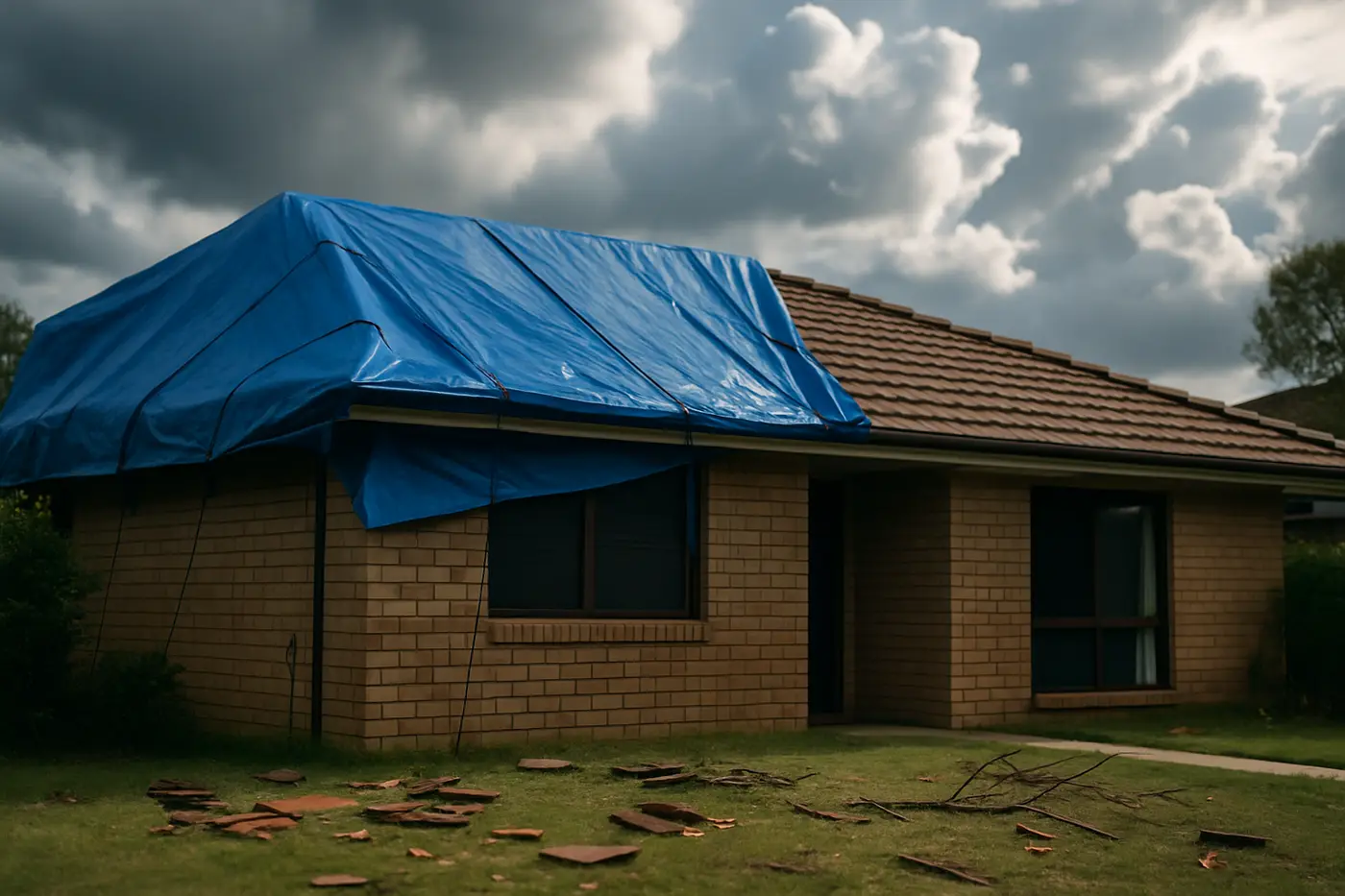
Brisbane roof tarped with a heavy-duty tarpaulin after storm damage

Free quote: Storm Damage Roof Repairs

Australian format - we'll text you to arrange your inspection.
Add brief description (optional)
How urgent?

Free inspection, photo report and quote. No obligation. Privacy.

What's included with our storm damage roof repairs service

Every job includes the basics below — no surprise extras tacked on when the invoice arrives.

  • Emergency make-safe and heavy-duty tarping to stop active water entry
  • Full storm damage assessment — tiles, metal sheets, ridges, flashings, gutters
  • Hail impact inspection with photo evidence for tile and Colorbond roofs
  • Insurance-ready damage reports and itemised repair scopes
  • Temporary repairs that hold until your insurer approves the permanent scope
  • Permanent repairs by QBCC-licensed roofers once the claim is settled
  • Storm season triage — active leaks prioritised over cosmetic damage

When to get us out

Signs your roof needs attention

Not sure if it's urgent? If you're seeing any of the below on your Brisbane home, don't wait for storm season to find the weak point — a small leak becomes a ceiling repair fast.

  • Water coming through the ceiling or light fittings during or after a storm
  • Tiles visibly cracked, displaced or lying in the yard after a hail or wind event
  • Metal sheets lifted, peeled back or flapping in the wind
  • Sagging or ballooning ceiling plaster — water is pooling above it
  • Ridge capping chunks or mortar in the gutters after a blow
  • Dents across a Colorbond roof or fractured tiles after hail
  • Gutters torn away or overflowing into the eaves during downpours

Never climb a wet roof after a storm

Wet tiles and metal sheets are treacherously slippery, damaged sections can give way without warning, and downed powerlines may have energised gutters or wet surfaces. Stay off the roof, stay clear of fallen lines, and leave the make-safe to roofers with the gear to do it safely. If the structure is dangerous or lines are down, that's a job for emergency services and Energex before anyone else.

How we fix it

About this service in Brisbane

Brisbane’s storm season runs November to March, and it doesn’t ease into things. Supercells build over the ranges on hot, humid afternoons and arrive with wind, giant hail and rainfall rates that find every weak point in a roof within minutes. If you’re reading this with water coming through the ceiling, skip ahead — get a quote online with a couple of photos and we’ll triage you. If the sun’s out and you’re preparing, even better.

First hour after storm damage: what to do

  1. Stay off the roof. Wet tiles and metal are lethally slippery, and storm-damaged sections can collapse underfoot. If powerlines are down anywhere near the house, treat gutters and wet ground as live and stay well clear.
  2. Control the water inside. Buckets under drips, furniture and electronics moved, rugs up. If the ceiling is ballooning, water is pooling above the plaster — don’t stand under it.
  3. Kill power to affected circuits if water is anywhere near light fittings or the switchboard, and call an electrician before re-energising.
  4. Photograph everything — the ceiling, the water, any debris in the yard, the time and date. Your insurer will want evidence of what the storm did before anything was moved or repaired.
  5. Arrange the make-safe. That’s the SES for free emergency tarping during declared events, or a private roofer for a faster, commercial-grade job you can usually claim back.

SES or private make-safe?

The SES (132 500) does an enormous job after major Brisbane storms, and if your situation is dangerous or you simply can’t fund a private call-out, use them without hesitation. The trade-offs are practical: after a big event they’re working through thousands of requests in priority order, so tarps can be days away, and their job is temporary protection only — nobody follows up with an assessment or repair.

A private make-safe costs $300-$800 depending on access and area, arrives sooner in most cases, uses heavy tarps battened and weighted to survive the next cell rather than draped over the ridge, and flows straight into the damage report and permanent repair. Most home policies cover reasonable emergency make-safe costs as part of the storm claim — keep the invoice and photos.

Hail damage: tiles and Colorbond fail differently

The 27 November 2014 hailstorm remains the reference event for Brisbane roofs — hail to tennis-ball size across the inner suburbs, tens of thousands of damaged homes, and one of the costliest insurance events Queensland has seen. But it doesn’t take a record-breaker. Hail of 2-3cm, which the south-east sees most summers somewhere, is enough to damage both major roof types:

  • Concrete and terracotta tiles crack, chip and shatter on impact. Some fractures are obvious; many are hairline cracks that only leak weeks later. Fractured tiles are functional damage and insurers generally accept them as such.
  • Colorbond and metal roofs dent rather than crack. Small, shallow dents on the pan of the sheet are often classed cosmetic — but heavy hail fractures the protective coating (inviting rust later), crushes ribs, splits translucent sheeting, and wrecks whirlybirds, vents and flashings. The line between cosmetic and functional is exactly where hail claims get argued, which is why documentation matters.

After any hail cell crosses your suburb, a free inspection is worth having even if the roof looks fine from the driveway. Roof damage is rarely visible from the ground, and claims lodged months later — when the hairline cracks finally leak — are far harder to link back to the storm.

How the insurance process actually runs

Storm damage is a standard insured event on Australian home policies. The friction points are scope and causation, and both are won with documentation. Our process is built around that:

  1. Make-safe first, with photos of the damage before the tarps go on.
  2. Full assessment — every broken tile, dented sheet, displaced ridge cap and damaged flashing photographed and located on the roof.
  3. Itemised scope of works you lodge with your claim or hand to the insurer’s assessor. Assessors are often working from the ground or a drone; our report is from on the roof.
  4. Repair to the approved scope once the insurer signs off, with a written workmanship warranty. If the insurer’s scope comes back lighter than the damage, our report is the evidence you use to query it — politely, in writing, and usually successfully.

One thing we don’t do: inflate scopes. Padded claims get knocked back, delay your repair, and drag every honest tradie’s reports into suspicion. A tight, photographed, defensible scope gets approved faster.

Temporary versus permanent repairs

Everything in the first days after a storm is temporary: tarps, refixed sheets, emergency flashings. Built well, a temporary repair holds through further rain for the weeks a claim takes to assess. But Queensland UV destroys tarps in months, not years — a roof still under blue plastic in June is a roof collecting mould and secondary water damage. The permanent repair — new tiles, colour-matched sheets, rebedded ridge capping, proper flashings — is the job, and anything over $3,300 in value legally requires a QBCC-licensed contractor. Check the licence on the QBCC register before you sign; storm-chasing door-knockers surge into damaged suburbs after every major event, and unlicensed work can void both your warranty rights and your insurance.

Before the next storm season

The cheapest storm repair is the one you never need. Every October we run pre-season inspections across Brisbane: ridge capping repointed, cracked tiles swapped, rusted screws replaced, valleys and gutters cleared, overhanging branches flagged. Most storm damage starts at a pre-existing weak point — the storm just presents the invoice. Dated photos of a sound, dry roof also make any future claim dramatically simpler.

Whether it’s 11pm with water on the floorboards or a quiet Sunday in October, the first step is the same: get a quote online or book a free inspection, and we’ll take it from triage to a roof that’s ready for the next cell.

Our process

From inspection to finished roof — four clear steps

How the job runs

Storm Damage Roof Repairs Brisbane

  1. 1

    Step 1

    Get in touch — any hour in storm season

    Get a quote online with a few photos if it's safe to take them. We triage by severity: active water entry and structural exposure jump the queue.

  2. 2

    Step 2

    Make-safe and tarp

    We stop the water first — heavy-duty tarps properly battened and weighted, not draped. The damage is photographed before and after for your insurance claim.

  3. 3

    Step 3

    Assessment and insurance report

    A full roof inspection documents every impact point with photos, and we prepare an itemised scope of works you can lodge with your insurer or hand to their assessor.

  4. 4

    Step 4

    Permanent repair

    Once the claim is approved — or immediately, if you're not claiming — we complete the permanent repair, matched to your existing roof, with a written workmanship warranty.

Every job: workmanship warranty in writing · QBCC-licensed roofing · fully insured

Real Brisbane rates

What you can expect to pay

Honest pricing based on actual Brisbane market rates. Final quote always confirmed in writing after a free inspection, before any work begins — no hidden extras.

Job typeBrisbane range (AUD)
Emergency make-safe and tarping$300-$800
Storm damage inspection and photo report$0
Minor storm repairs (tiles, flashings, resealing)$350-$1,500
Metal sheet replacement after wind damage$150-$350 per sheet
Insurance scope worksQuoted to scope

Ranges reflect typical Brisbane metropolitan area pricing for 2026. Every job starts with a free inspection and a fixed written quote — the number you approve is the number you pay.

Where we cover

Storm Damage Roof Repairs Brisbane — by Brisbane area

Same service, same prices, all Brisbane metropolitan suburbs. Each area has its own roof stock and fault patterns worth knowing about — tap your area below.

What customers say about this service

Recent storm damage roof repairs reviews

Sharon W.

The Gap

"Gum branch went through the tiles at 9pm in a January storm. Tarped by morning, photos taken for the insurer, and the report they wrote got the full scope approved without an argument. Permanent repair done three weeks later."
2026-01-19

Dinh N.

Sunnybank

"Hail came through just before Christmas. They inspected the Colorbond, documented every dent and two fractured skylights, and the itemised scope matched what the assessor approved. No drama, no upselling."
2025-12-22

Rob McA.

Albany Creek

"Big cell took half the ridge capping off. Make-safe was quick and the tarp held through two more storms, which frankly surprised me. One star off — the permanent repair took longer than quoted because tile stock was short after the event. Quality was spot on."
2026-02-08

Priya S.

Carindale

"Booked the free pre-season inspection after last summer's scare. They repointed loose ridge capping, swapped four cracked tiles and cleared the valleys. Cheap compared to what the neighbours spent after the last storm."
2026-08-30

Common questions

Storm Damage Roof Repairs Brisbane — your questions answered

  • Should I call the SES or a private roofer?
    The SES (132 500) is a volunteer emergency service for storm and flood damage — they do free temporary make-safes like tarping when major events hit, and they prioritise the worst-affected homes. After a big supercell they can be stretched across thousands of jobs, so waits can run to days. A private roofer costs money but comes sooner, uses commercial-grade tarps properly fixed down, and can carry straight through to assessment and permanent repair. Many insurers reimburse reasonable emergency make-safe costs — keep the invoice.
  • How fast can you get to us during a storm event?
    During routine weather, usually same day or next morning. After a major cell — the kind that puts hundreds of roofs out at once — we triage: active water entry into living areas and exposed structures first, contained leaks second, cosmetic damage after that. We'll give you an honest window rather than a promise we can't keep, and we won't put anyone on a roof while lightning or heavy rain is still overhead.
  • Will my insurance cover storm damage roof repairs?
    Storm damage is a standard insured event on almost every Australian home policy, and that generally includes hail, wind and rain entering through storm-created openings. What's typically excluded is damage from poor maintenance or gradual deterioration — a rusted-out valley that finally let go, for example. That's exactly why a detailed photo report matters: it documents that the damage is storm impact, not wear and tear. Check your PDS, lodge promptly, and keep every photo and invoice.
  • How do I tell hail damage on tiles versus a Colorbond roof?
    They fail differently. Concrete and terracotta tiles crack, chip or shatter on impact — damage that lets water in and is usually accepted by insurers as functional damage. Colorbond dents rather than cracks; small dents are often cosmetic, but large hail can fracture the coating (leading to rust later), crush ribs, or damage flashings, translucent sheeting and whirlybirds. Assessing metal hail damage fairly takes experience — we document dent density, coating fractures and damaged fittings so the claim reflects the real condition.
  • What actually happens with the insurance claim — do you deal with the insurer?
    You lodge the claim with your insurer; only you can do that. What we do is give you the ammunition: a photo-documented damage report, an itemised scope of works, and the make-safe invoice. When the insurer's assessor visits, our report keeps the scope honest — assessors sometimes miss damage that's only visible on the roof. If the insurer's scope comes back short, you're entitled to query it, and our documentation is what you query it with. We then complete repairs to the approved scope.
  • What's the difference between a temporary and permanent repair?
    A temporary repair stops water entry now: tarps, temporary flashings, refixing what can be refixed. It's built to hold for weeks, through more rain, while your claim is assessed — but it isn't the fix. The permanent repair replaces broken tiles, damaged sheets, ridge capping and flashings to pre-storm condition or better. Don't let anyone sell a silicone-and-tarp job as 'done'; and don't leave a tarp up for six months, because tarps degrade in Queensland UV faster than most people expect.
  • How bad can Brisbane hail actually get?
    Very. The 27 November 2014 Brisbane hailstorm dropped hail up to tennis-ball size across the inner city and generated one of the costliest insurance events in Queensland's history, with tens of thousands of homes damaged. Supercells with giant hail have hit the south-east repeatedly since. It doesn't take a record-breaker either — even 2-3cm hail cracks tiles and fractures Colorbond coating. If a hail cell has crossed your suburb, an inspection is worth it even when the roof looks fine from the ground.
  • The storm is coming — anything I can do before November?
    Plenty, and October is the time to do it. Get loose ridge capping repointed, cracked tiles swapped, rusted fasteners replaced, and gutters and valleys cleared — most storm damage starts at a weak point that already existed. Trim overhanging branches. Photograph your roof and ceilings while everything is dry: dated 'before' photos make an insurance claim dramatically simpler. A pre-season inspection is free, and it's the cheapest storm insurance you'll ever buy.

Need storm damage roof repairs in Brisbane?

Get a free Brisbane quote in under 60 seconds.

QBCC-licensed Brisbane roofers, seven days a week. Tell us your suburb and what's happening up there — we'll come back fast with a quote and an inspection time.