How we fix it
About this service in Brisbane
Tile roofs dominate Brisbane’s suburbs for a good reason — terracotta and concrete both handle decades of subtropical sun and storm better than almost any other covering. But every tile roof accumulates small failures: a tile cracked by a tradie’s boot, mortar fretting along the ridge, a valley iron quietly rusting under leaf litter. Individually they’re cheap fixes. Ignored through a couple of storm seasons, they become ceiling repairs, insulation replacement and possums in the roof cavity.
This page covers the repairs we do every week on Brisbane tile roofs, what they cost in 2026, and how to tell repair apart from restoration-or-replace territory.
The usual suspects on a Brisbane tile roof
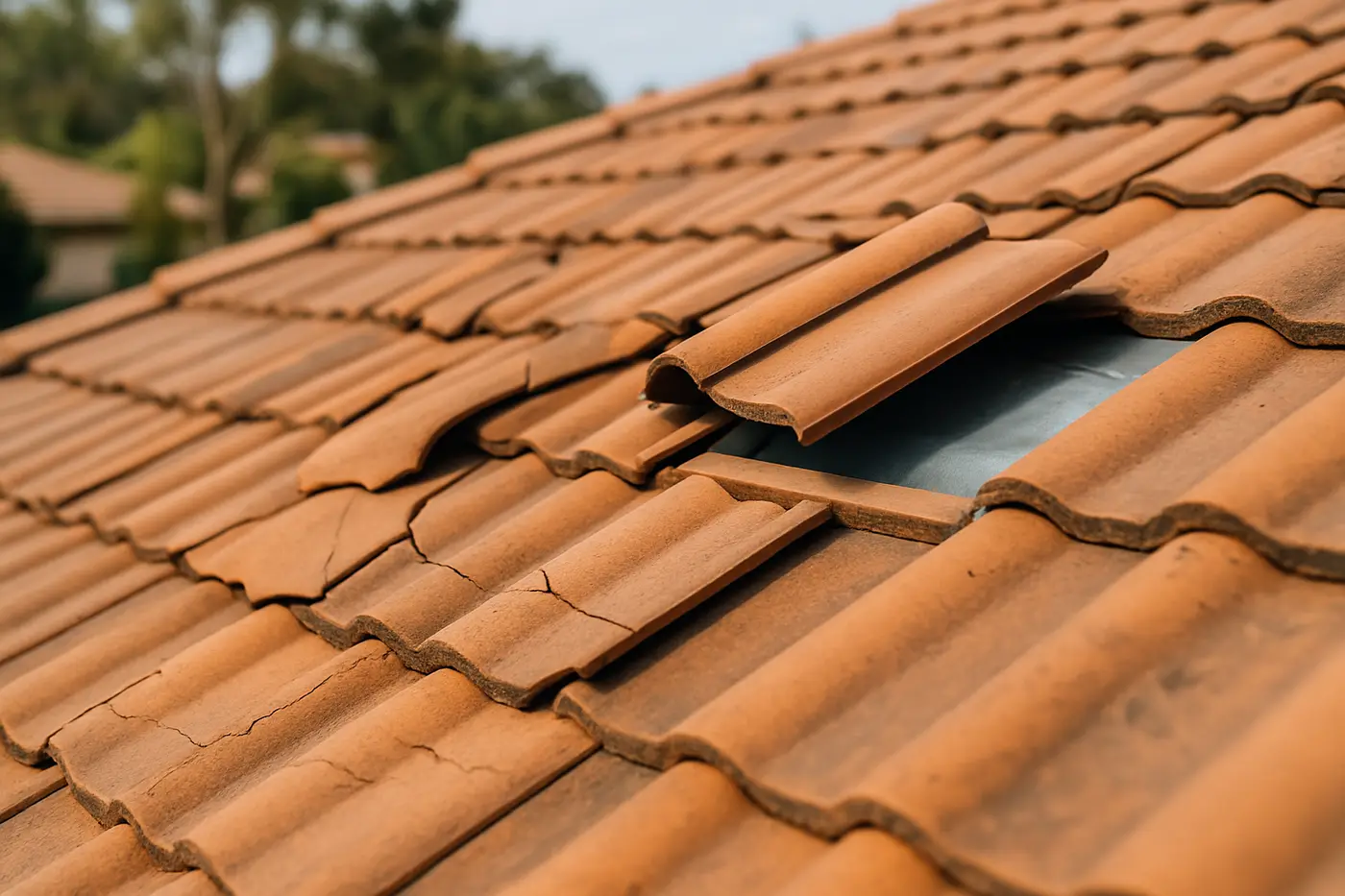
Cracked and slipped tiles
The most common call-out, and the causes are predictable: foot traffic from solar, aerial and pay-TV installers; hail; falling branches; and on older terracotta, plain age-related brittleness. A slipped tile — one that’s dropped out of its course — leaves an even bigger opening than a crack.
The trap is the phrase “it’s not leaking.” Under most tiled roofs sits sarking, a reflective membrane that catches incidental water. A cracked tile over sarking often shows no symptoms for months while water quietly tracks along the membrane, finds a tear or a batten fixing, and soaks insulation before the first ceiling stain appears. Sarking is the backup — the tile is the roof. (Plenty of older Brisbane roofs, especially pre-1970s, have no sarking at all, in which case a cracked tile leaks on the first decent shower.)
Our guide on cracked roof tiles — repair, restore or replace goes deeper on judging severity.
Fretting ridge mortar
If your gutters collect grey crumbs, the bedding mortar under your ridge caps is fretting — standard for concrete tile roofs built from the 60s through the 80s. Small mortar patches are part of a normal repair visit; once it’s failing along whole ridge lines, the correct fix is rebedding and repointing, and we’ll quote it as its own scope rather than bury it in patch work that won’t last.
Rusted valley irons
Valleys — the internal channels where two roof planes meet — carry a disproportionate share of your roof’s water into the gutters. The metal tray under the cut tiles is the workhorse, and on homes from the 60s, 70s and 80s in suburbs like The Gap, Albany Creek and Capalaba the original galvanised trays are now at or past the end of their life. Leaf litter is the accelerant: it holds moisture against the metal year-round, especially on leafy blocks. A rusted-through valley leaks straight into the cavity and is one of the most common “mystery leak” sources we diagnose. Replacement means lifting the tile courses along the valley, fitting a new galvanised or Colorbond tray, and re-laying the tiles — typically $700-$1,400 per valley.
Bird and possum entry points
One broken tile or a lifted valley edge is an open invitation. Birds nest in the cavity and pack valleys with debris; possums are worse — persistent, destructive, and protected. Under Queensland rules, possums must be removed humanely by someone licensed, and they can’t simply be dumped elsewhere — so lasting fixes are about exclusion: get the animal out, then seal every entry point the same day. We close off the roof side of that equation as part of a standard repair visit.
Matching discontinued tiles
Brisbane’s tile stock spans a century — pre-war terracotta in Paddington, post-war concrete profiles across the middle and outer suburbs — and a large share of those profiles are no longer made. “You can’t get those anymore” is not the end of the conversation:
- Salvage stock. Yards around South East Queensland carry tiles recovered from demolitions and reroofs. Most discontinued profiles can be sourced with some hunting.
- Harvest and swap. Where no true match exists, we take sound matching tiles from a low-visibility face of your own roof — behind a gable, a face screened by trees — and fit the nearest substitute profile there instead. Street-facing planes stay uniform.
- Colour honesty. A new tile in a 40-year-old roof will read slightly newer no matter what. We place replacements where it matters least and tell you upfront what the match will look like.
If you’re weighing up terracotta against concrete for the long run, our terracotta vs concrete comparison covers durability, weight and cost.
Repair, restore or replace: the honest ladder
Repair is right when damage is localised and the tiles are structurally sound — the overwhelming majority of the calls we attend.
Restoration is better value once problems are widespread: fretting mortar along every ridge, eroded concrete tile surfaces, multiple leak points. Paying for repeated repair visits on a roof that needs restoring is money down the downpipe.
Replacement enters the conversation when tiles themselves are failing en masse — delaminating terracotta, fretting concrete — and no amount of surface work changes the substrate.
We tell you which rung you’re on at inspection, with photos. Repairs are the bulk of our work, so we have no incentive to talk you up the ladder.
Storm season changes the maths
From November to March, a loose tile is a liability multiplier. Storm cells that sweep Brisbane drive rain sideways and lift anything not fixed down; a cracked tile that seeps in April becomes a ceiling collapse risk in a January downpour, and storm damage call-outs peak exactly when every roofer in the city is flat out. The economics are simple: a $400 repair visit in September beats an $850 make-safe, a tarp and an insurance excess in January. If your roof hasn’t been looked at since last summer, get it inspected before November.
Book a free tile roof inspection
Every job starts with a full walk-over — tiles, ridges, valleys, flashings, entry points — and ends with a photo report and a fixed written quote. No pressure, no invented urgency; if the roof’s fine, we’ll tell you that too.
Get a quote online or book a free inspection anywhere across Brisbane — northside, southside, bayside and the western suburbs.